Unlocking Your Home Equity: The Strategic Power of a 20% Down Payment

If you are planning to purchase your next home, you have likely encountered the traditional guideline recommending a 20% down payment. While many loan programs allow qualified buyers to put down significantly less, a growing number of repeat homebuyers are choosing to put down 20% or more.
According to data from the National Association of Realtors, the typical repeat homebuyer puts down roughly 23%, more than double the standard down payment of a first-time buyer.
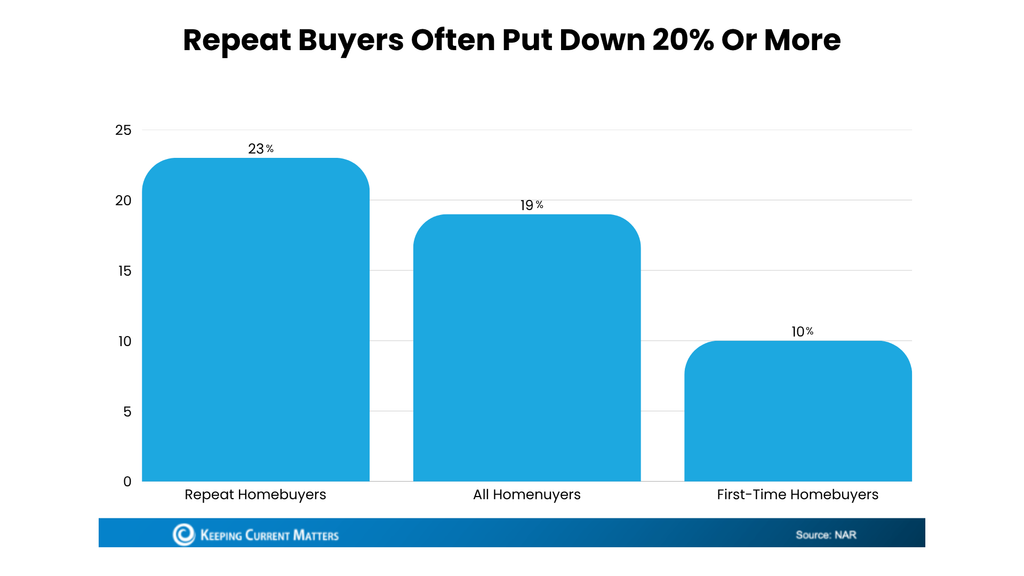
The primary driver behind this shift is existing home equity. Over time, as you pay down your mortgage balance and home values appreciate, the difference between what you owe and what your home is worth builds up. When selling a current home, that accumulated equity can be rolled directly into your next purchase.
If your accumulated equity makes a larger down payment possible, doing so provides several key financial advantages:
- Lower Monthly Payments: Borrowing less money directly reduces your total loan balance. In today’s interest rate environment, minimizing the amount financed keeps your ongoing monthly housing commitment more manageable.
- Reduced Long-Term Interest Costs: Interest is calculated on the remaining loan principal. Lowering your starting balance from 95% to 80% of the home’s value substantially reduces total interest paid over the life of the loan.
- Elimination of Private Mortgage Insurance (PMI): On conventional loans, down payments below 20% typically require monthly PMI fees to protect the lender. Reaching the 20% threshold waives this requirement, keeping more money in your monthly budget.
- Stronger Financial Positioning: A higher down payment signals financial stability during the purchase process, providing greater flexibility and leverage when negotiating purchase terms.
While a 20% down payment is not mandatory for homeownership, leveraging your accumulated equity to reach that target can significantly lower ongoing housing expenses and strengthen your overall financial health.
The Bottom Line
Selling a current home while preparing to buy another involves complex moving parts, from calculating your true net equity after closing costs to timing your sale, pricing accurately in a competitive market, and structuring your new mortgage. Estimating these numbers on your own can leave significant money on the table or lead to unexpected out-of-pocket expenses.
Navigating this transition efficiently requires personalized financial analysis and expert market strategy. Through your employee benefits program, you don’t have to figure it out alone. Connecting with a dedicated advisor gives you expert guidance to evaluate your home’s current market value, accurately calculate your available equity, and build a seamless plan to maximize your buying power.
Moving Forward with Confidence
Understanding how your current home equity aligns with your long-term goals is an important first step in planning your next move. Schedule your free consultation today to explore your options and run the numbers for your household.


SupportSquad@AdvantageHomePlus.com | (800)511-2197
The information contained and the opinions expressed in this article are not intended to be construed as investment advice. Advantage Home Plus does not guarantee or warrant the accuracy or completeness of the information or opinions contained herein. Nothing herein should be construed as investment advice. You should always conduct your own research and due diligence and obtain professional advice before making any investment decision. * Real estate commission contributions are available as state laws allow.