Think Home Prices Will Crash? Here’s What the Experts Actually Expect

¿Qué pasa si esa caída que estás esperando nunca llega?

One of the biggest reasons buyers are still sitting on the sidelines is because they think home prices are going to come down.

  • Some believe a crash is coming and they’ll get a better deal if they hold off.
  • Others worry they’ll buy now and watch their home’s value fall later.

And nobody wants to overpay or buy right before values drop. But here’s the question worth asking:

What if the crash you’re waiting for isn’t actually coming?

Because that’s what the latest data suggests.

If you’ve spent any time online lately, you’ve seen posts claiming home prices are about to come crashing down. And it’s true that some markets are seeing small price declines right now.

But that’s not the same thing as a nationwide crash.

While some places are going through a price adjustment, Realtor.com data shows home prices are still rising in 71% of housing markets across the country. The trouble is, since negative news sells, you’re seeing more coverage about how a handful of markets are seeing declines, than how the majority are still seeing prices rise. And that’s unfortunate.

It’s exactly why a lot of buyers end up with the impression that prices are falling everywhere when they’re not. So how do you really know where prices are really headed from here?

Every quarter, more than 100 economists, housing experts, and market analysts are asked where they think home prices are headed based on the latest data available.

And despite all the uncertainty in today’s market, there’s one thing they largely agreed on:

They don’t think a crash is coming.

In fact, the average of all their forecasts calls for home prices to rise every year for at least the next 5 years (see graph below):
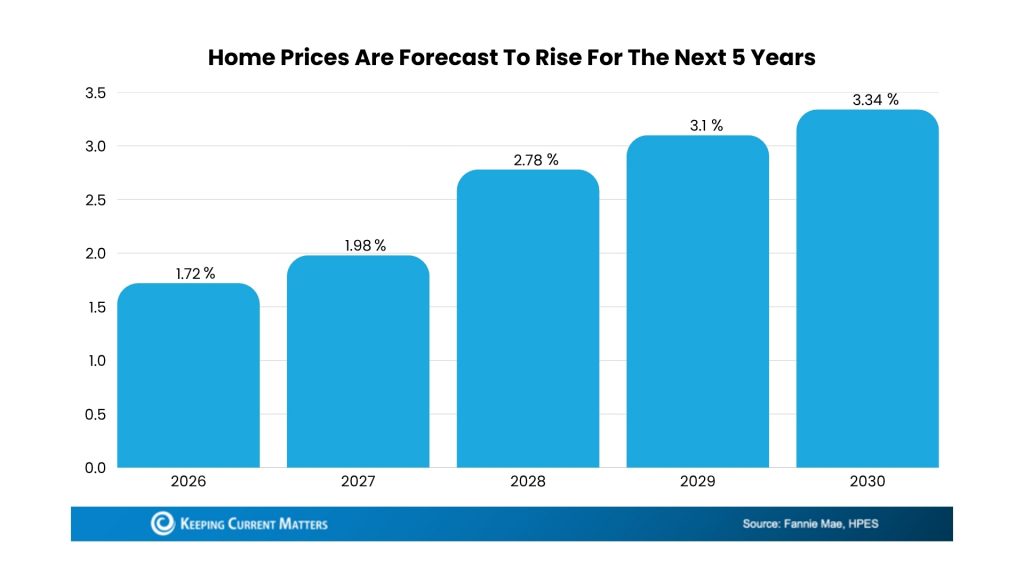
The point is that the overwhelming expectation isn’t for prices to fall. It’s for prices to rise at a more normal pace. And just in case you’re looking at the forecasts and saying: “of course they’d say that” – know that this survey doesn’t just include optimists. It includes pessimists too.
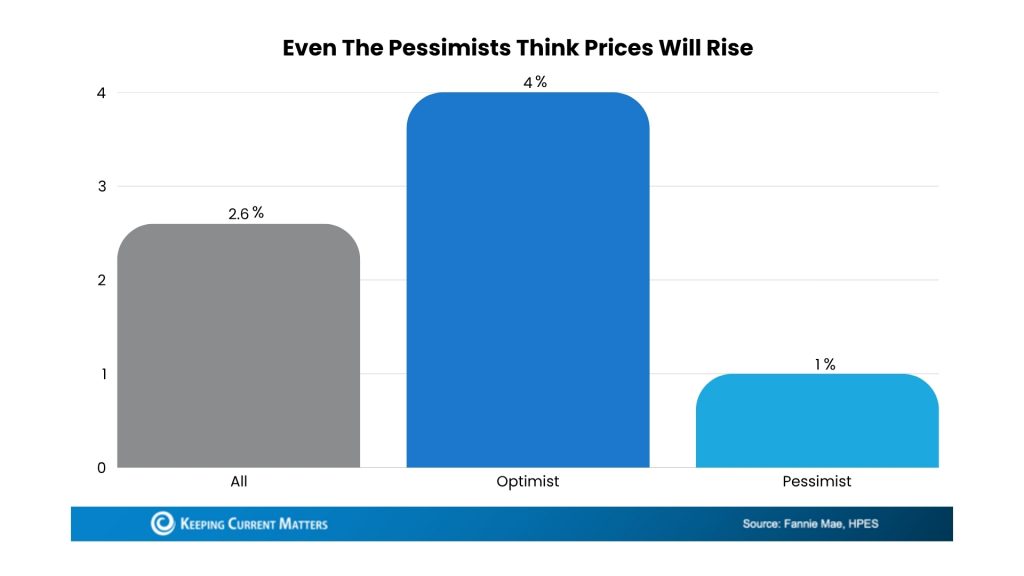
Think about that for a second. The debate among experts isn’t whether prices will crash. It’s how much they’ll rise.

That’s a very different conversation than the one happening across social media.

So, if you’re putting off your move until prices come down, you may be disappointed. According to the experts, a widespread crash isn’t in the cards.

In fact, based on the HPES forecast, a buyer who purchased a $400,000 home this January would gain nearly $40,000 in equity over the next five years from appreciation alone, even in this more moderate market (see below):
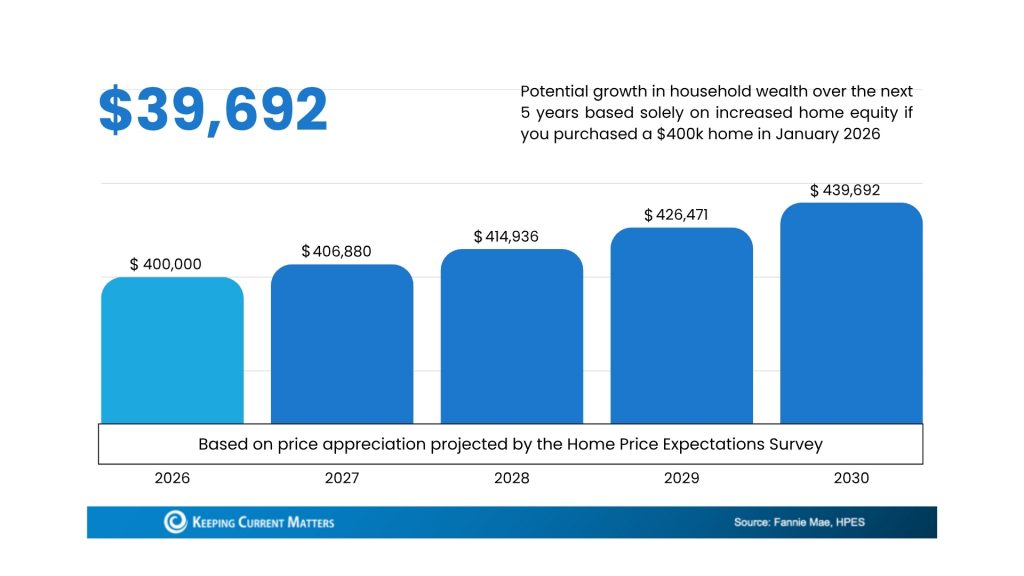
Of course, this all depends on local market conditions. This forecast is a national average. But broadly speaking, if the experts are right, the bigger risk isn’t that prices will crash. It may be waiting for a crash that never comes.

Because depending on your market, if you wait, you could be missing out on $40k in equity or paying 40k more in 5 years for the same house.

A lot of buyers are waiting because they think prices will fall, but that’s not what the experts are saying.

If you’re trying to decide whether waiting still makes sense, connect with your Employee Homeownership Program Advisor. They’ll help you understand what’s happening in your local market and what it could mean for your plans.


Employee Homeonwrship Program

SupportSquad@AdvantageHomePlus.com | (800)511-2197 

Making the Market Work for You: Real Examples of Strategic Homeownership

Navigating real estate options can feel overwhelming when market conditions constantly shift. However, housing remains a foundational element of long-term financial stability and personal wellness. Making informed, educated choices is the best way to ensure your real estate decisions align with your broader financial goals.

Navigating real estate options can feel overwhelming when market conditions constantly shift. However, housing remains a foundational element of long-term financial stability and personal wellness. Making informed, educated choices is the best way to ensure your real estate decisions align with your broader financial goals.

Fortunately, access to educational tools and professional financial planning resources can give you a significant advantage. By utilizing available employer-sponsored wellness benefits, individuals can cut through the noise and build actionable strategies. Here is how three working professionals successfully mapped out their journeys.

Sarah, a school administrator, wanted to purchase her first property but felt blocked by high upfront costs and a lack of real estate knowledge. Instead of giving up, she connected with an educational financial coach. Through careful budget tracking and an introduced roadmap for first-time buyers, she discovered tailored down payment options. Ten months later, she confidently purchased a townhome within her budget.

David, a logistics coordinator, had been watching interest trends closely, wondering if he could optimize his current mortgage. By reviewing his financial health with an objective planning expert, he calculated how consolidating high-interest debt into a restructured mortgage layout could improve his monthly cash flow. The move freed up significant capital, allowing him to build an emergency savings fund.

Elena, a project manager, needed to upgrade to a larger property for her growing family but was deeply stressed about the timing of selling and buying simultaneously. Educational support and structured planning tools helped her evaluate bridge options and low-stress financing strategies. Ultimately, she managed a seamless move without rushing her timeline.Elena, gerente de proyectos, necesitaba mudarse a una propiedad más grande para su familia en crecimiento, pero se sentía muy estresada por coordinar la venta de su casa y la compra de la nueva al mismo tiempo. El apoyo educativo y las herramientas de planificación estructurada le ayudaron a evaluar opciones de financiamiento temporal (créditos puente) y estrategias de bajo estrés. Al final, logró una mudanza impecable y sin complicaciones, respetando sus propios tiempos.

No matter what the broader market looks like, individual success always comes down to proactive planning and objective education. Understanding credit health, true purchase capacity, and mortgage structures allows you to act with total confidence. Even if a move isn’t on your immediate horizon, taking the time to educate yourself today ensures you are fully prepared when the right opportunity arrives.

Are you ready to explore your options, build a customized financial plan, or get answers to your homeownership questions? Schedule your free consultation today.

Employee Homeonwrship Program

SupportSquad@AdvantageHomePlus.com | (800)511-2197 

Should You Pay for Your Buyer’s Closing Costs? What Sellers Need To Know.

Should You Pay for Your Buyer’s Closing Costs? What Sellers Need To Know.

A few years ago, sellers could get away with saying “no” to just about everything.

  • No repairs.
  • No concessions.
  • No negotiation.

If buyers wanted the house, they pretty much had to take it on the seller’s terms. But now that inventory’s grown, negotiations are becoming a normal part of the process again.

That’s why one of the most important things sellers need to understand right now is this:

The goal isn’t to “win” every negotiation.

Sometimes, it’s worth meeting buyers where they are to get a deal done, fast. One example? Helping with a buyer’s closing costs.

Let’s break that down, so you know what to expect if it comes up in your sale.

Closing costs are the extra expenses buyers pay on top of their down payment when they purchase a home. Freddie Mac gives some examples:

  • Loan origination fees
  • Appraisal and inspection costs
  • Title and attorney fees
  • Survey fees and more

Typically, buyer closing costs range from about 2% to 5% of the home’s purchase price. So, on the typical $400,000 home, that could mean anywhere from $8,000 to $20,000 out of pocket.

And in today’s affordability-challenged market, that upfront cash can be a major hurdle for some buyers – even if they can comfortably afford the monthly mortgage payment itself. 

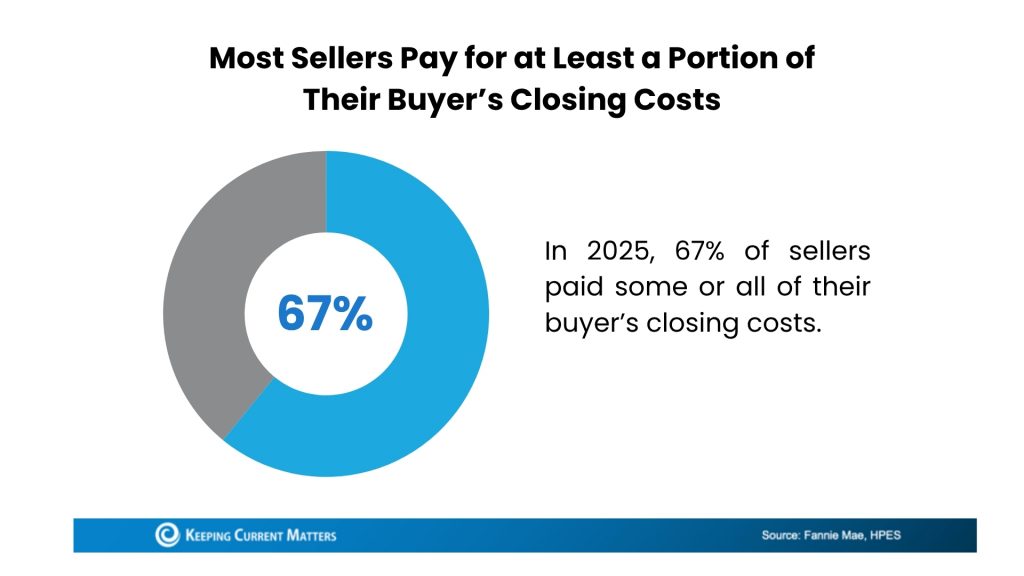
According to the latest data from Zillow67% of sellers reported paying some or all the buyer’s closing costs in 2025 (see chart below):

Now, that doesn’t mean every seller is doing it. And it doesn’t mean every seller should. But it does show how common concessions have become as the market has shifted. And that’s important for you to know.

This is where many sellers get stuck. They hear “help with closing costs” and immediately think: “Why should I pay for their expenses?”

But that’s not always the right way to look at it. You’ve got to consider who has the leverage in today’s market.

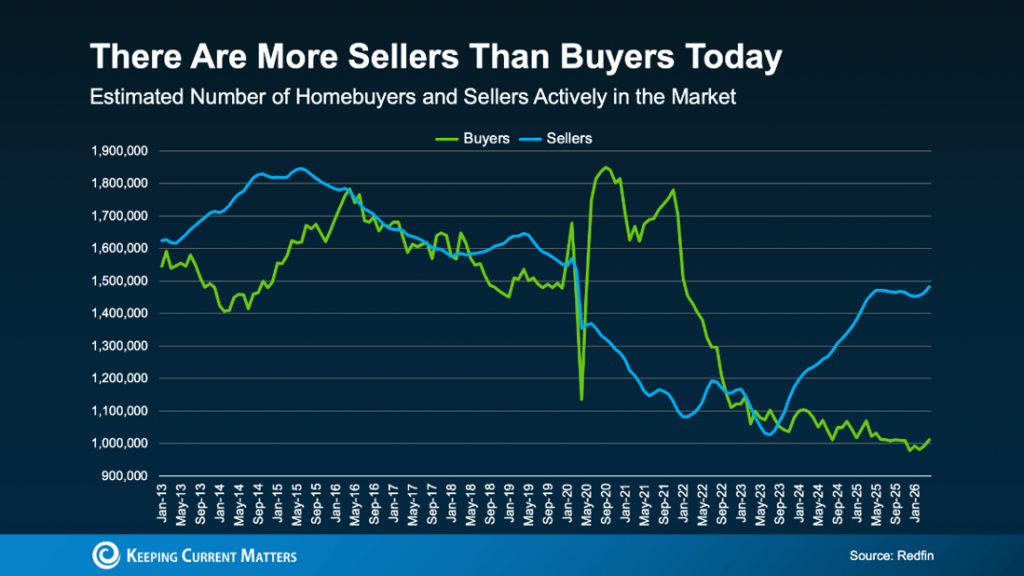
Redfin data shows there are more sellers than buyers active today. And that shifts the market dynamics (see graph below):

That doesn’t mean every market favors buyers. Far from it. In some areas, homes are still selling quickly and sellers have plenty of leverage. But in others, buyers have more room to negotiate than they’ve had in years.

That’s why local market conditions matter so much when you make your decision.

For example, helping with closing costs may be worth considering if:

  • There are a lot of homes for sale in your area
  • Your house has been sitting on the market for longer than expected
  • You’ve had showings, but no offers
  • You’re motivated to move quickly
  • Or you’re trying to keep a deal together during negotiations

After all, if it’s the thing that helps bring a serious buyer across the finish line, it could be well worth it.

Just remember, being flexible doesn’t mean saying “yes” to every request.  It means understanding which compromises actually help you accomplish your goals. Because there are always alternatives.

Redfin suggests considering other concessions if you’re not interested in helping with closing costs, like:

  • A home warranty
  • Repair credits
  • Flexible closing dates, or
  • Leave behind appliances or furniture

The right answer depends on what buyers in your market are asking for and what matters most to you. That’s exactly why working with your Employee Homeownership Program Advisor is so important.

Are you ready to explore your options, build a customized financial plan, or get answers to your homeownership questions? Schedule your free consultation today.

Employee Homeonwrship Program

SupportSquad@AdvantageHomePlus.com | (800)511-2197 

Renting vs. Buying: Unpacking the Invisible Expenses for Smart Financial Planning


As we reach the midpoint of the year, many employees find that their financial priorities have shifted since January. While the national conversation often fixates on whether to rent or buy based purely on market prices, a more vital question for your personal wellness is: “Is my current housing budget accounting for the full cost of my living situation?”

Instead of waiting for a “perfect” moment to relocate or purchase, June offers a unique opportunity to evaluate the hidden line items in your housing costs to streamline your budget and provide immediate relief to your monthly cash flow.

For many households, the primary financial challenge isn’t just the base monthly rent or mortgage payment; it’s the accumulation of other, less visible monthly obligations. Taking an honest look at your complete housing expenses today can be a powerful move if it allows you to identify hidden leaks and lower your total monthly out-of-pocket expenses.

Even if current market options seem complex, evaluating the full spectrum of housing costs can help you achieve specific goals:

  • Repositioning for Flexibility: Adjusting your short-term savings and spending habits to better align with your long-term retirement or savings plans.
  • Identifying Renter Overhead: Uncovering overlooked apartment costs like mandatory renters insurance, amenity fees, parking, or escalating utility setups.
  • Planning for Home Upkeep: Factoring in property taxes, insurance adjustments, and the critical routine maintenance funds required when you become your own landlord.
  • Managing Debt Ratios: Seeing how these auxiliary housing expenses interact with your credit health and total debt-to-income ratio.

The “wait and see” approach often results in carrying unnecessary financial stress longer than necessary. By shifting your focus from “market timing” to “financial strategy,” you can make progress now and establish a clear financial roadmap for your future living situation.
To help you determine if the math works in your favor, your company provides a homeownership benefit focused on clear, objective education. This resource allows you to compare different financing scenarios, demystify invisible expenses, and identify where you can save the most money based on your unique situation.

Your Employee Homeownership Program is here to help you plan, navigate your options, and save money along the way.

Book a Strategy Session to get a clear, personalized path forward – based on your unique situation.

Employee Homeonwrship Program

SupportSquad@AdvantageHomePlus.com | (800)511-2197 

The “Stay-In-Place” Strategy: Transforming Your Current Home to Fit Your Future

When a household starts outgrowing its layout or notices the decor aging, looking up local property listings feels like the most logical next step.

When a household starts outgrowing its layout or notices the decor aging, looking up local property listings feels like the most logical next step. However, jumping headfirst into a competitive purchasing environment brings a massive wave of logistical friction and lifestyle disruption.
Before committing to a frantic search for a new address, smart financial planning requires exploring what is already right under your feet. July provides an ideal seasonal pause to audit your current environment and uncover hidden spatial potential. Reimagining the square footage you already possess can safeguard your savings while offering profound relief from the claustrophobia of an unoptimized layout.

Deciding to change neighborhoods involves a steep financial toll that goes far beyond the price tag of a new home. Sellers and buyers face thousands of dollars in hidden transactional drains, from real estate commissions and legal fees to moving companies and storage containers. Taking a cold, hard look at your current real estate assets right now shields you from these sunk costs, allowing you to reallocate those exact funds directly into value-boosting property enhancements instead.

“True housing satisfaction rarely requires a brand-new zip code; it stems from intentionally engineering your existing home to generate breathing room for both your family and your wallet.”

Even if current market options seem complex, evaluating the full spectrum of housing costs can help you achieve specific goals:

  • Repositioning for Flexibility: Planning small, phased updates carefully to ensure your home adjustments better align with your long-term retirement or savings plans.
  • Avoiding Moving Friction: Eliminating the thousands of dollars spent on moving logistics and real estate fees, redirecting that capital directly into your home’s value.
  • Maximizing Existing Footprints: Repurposing underutilized areas—like attics, basements, or garages—into functional home offices, gyms, or bedrooms.
  • Locking in Community Value: Preserving your established neighborhood ties, school districts, and commute times while still achieving a “new home” feel.

Falling into the trap of “analysis paralysis” often leads to overcomplicating your finances and stalling your progress altogether. By pivoting your mindset from trying to solve every financial puzzle at once to simply mastering one small habit at a time, you can cut through the noise and build immediate, sustainable momentum.

To help you determine if the math works in your favor, your company provides a homeownership benefit focused on clear, objective education. This resource allows you to compare different financing scenarios, evaluate home equity options for upgrades, and identify where you can save the most money based on your unique situation.

Your Employee Homeownership Program is here to help you plan, navigate your options, and save money along the way.

Book a Strategy Session to get a clear, personalized path forward – based on your unique situation.

Employee Homeonwrship Program

SupportSquad@AdvantageHomePlus.com | (800)511-2197 

Smart Summer Upgrades: How to Build Home Equity with Easy Cosmetic Fixes


Summer is the season of home updates. Whether you are thinking about selling your home in the near future or simply want to build long-term financial stability, you don’t need a massive budget or a full-scale renovation team to make a significant impact.

Many times, the smallest, most manageable cosmetic updates are the ones that yield the highest return on investment. If you are looking for a few productive weekend projects this July, here are the smart, budget-friendly updates that real estate professionals love to see.

First impressions matter immensely. Simple landscaping updates can instantly boost your home’s perceived value. Trim overgrown bushes, edge the lawn, and add a fresh layer of dark mulch to your flower beds. A clean front yard signals that the entire property has been well cared for.

Your front door is the focal point of your home’s exterior. Give it a fresh coat of paint in a classic, appealing color—like deep navy, charcoal, or clean black—and swap out old, tarnished hardware for modern locks. This is one of the lowest-cost projects available, yet it consistently ranks high for visual appeal.

Inside the home, nothing transforms a space faster or more affordable than painting. Focus on high-traffic areas like the entryway or living room. Stick to warm neutrals or off-whites that make spaces feel larger, brighter, and more open.

Old, yellowing light fixtures or outdated cabinet hardware can make a home feel stuck in a different decade. Swapping out old light fixtures for modern LED alternatives and replacing kitchen cabinet knobs with matte black or brushed nickel finishes can make your space feel contemporary without the price tag of a full remodel.

Building equity and maintaining your home is a continuous process. You don’t have to tackle everything at once; progress, not perfection, is what truly makes the difference. If you ever want to know how these updates factor into your home’s overall market value, or if you’re curious about how to leverage your existing equity for your next financial goal, your company-sponsored benefits are always here to guide you.

Your Employee Homeownership Program is here to help you plan, navigate your options, and save money along the way.

Schedule your free consultation today.

Employee Homeonwrship Program

SupportSquad@AdvantageHomePlus.com | (800)511-2197 

The Other Big Number: Demystifying Your Debt-to-Income Ratio


While a credit score usually gets all the attention when discussing housing readiness, lenders rely heavily on a second, equally important metric to evaluate your financial health. This lesser-known number measures the relationship between your monthly earnings and your recurring financial obligations. Understanding how these two financial forces balance out is essential for anyone wanting to secure a stable financial future. July provides an excellent mid-year window to look closely at this equation, allowing you to adopt straightforward summer habits that naturally improve your standing and reduce financial stress long before you ever fill out a housing application.

For many households, the primary hurdle to major financial milestones isn’t a lack of income, but rather how much of that income is swallowed up by existing monthly payments each month. Calculating this percentage gives you an honest look at your true purchasing power, revealing exactly how free your cash flow is from historical liabilities. Taking a proactive look at this metric right now shields you from future loan roadblocks, enabling you to make slight adjustments to your daily routine that build real momentum.

Even if you are completely new to navigating financial metrics, adopting small, intentional habits during the summer months can create major positive shifts:

  • Trimming Unused Subscriptions: Auditing recurring auto-pays and monthly memberships that quietly inflate your minimum monthly obligations without adding value to your life.
  • Paying Down Minimum Balances: Directing seasonal bonuses or tax refunds toward small, high-interest balances to eliminate a monthly payment category.
  • Avoiding New Financing: Resisting the urge to open retail store cards or take on deferred-payment loans for summer purchases, keeping your slate clear.
  • Documenting Secondary Income: Properly tracking side gigs, freelance projects, or seasonal overtime to ensure your full earning power is accurately represented.

Operating in a purely reactive mode usually means making hurried financial choices under pressure when you are right in the middle of a major life transition. By shifting your energy toward proactive planning today and mastering your personal financial metrics early, you establish a solid foundation that ensures you are acting out of preparation, rather than necessity, when you are ready to make your next move.

To help you calculate your personal percentages and map out a clean baseline, your organization provides a comprehensive homeownership resource centered on objective financial literacy. This program gives you access to user-friendly planning tools and personalized guidance to help you model different scenarios and discover your best path forward.

Your Employee Homeownership Program is here to help you plan, navigate your options, and save money along the way.

Book a Strategy Session to get a clear, personalized path forward – based on your unique situation.

Employee Homeonwrship Program

SupportSquad@AdvantageHomePlus.com | (800)511-2197 

Why June is the Strategic Month for Future Homeowners

Moving past the common myth that summer is a "slow" time allows you to gain a significant head start on your homeownership goals while others are distracted by the season.

As the weather warms up and calendars fill with vacations, many people assume the housing market simply hits a “pause” button until the fall. While it’s true that the pace of daily life changes in June, this shift actually creates a unique window of opportunity for employees focused on long-term financial health.

“Moving past the common myth that summer is a “slow” time allows you to gain a significant head start on your homeownership goals while others are distracted by the season.”

The idea that nothing happens in the real estate world during the summer is a misconception. In reality, June is often a time when new inventory stabilizes, giving you a clearer picture of what is available in your price range.

The primary hurdle for many isn’t a lack of homes; it’s a lack of “mortgage confidence.” To build that confidence, you must move from guesswork to facts by evaluating:

  • Your purchasing power: Understanding exactly what you can afford in today’s economic climate.
  • Debt-to-income ratio: Seeing how your current obligations affect your loan potential.
  • Credit health: Identifying small shifts that can lead to better interest rates

This clarity is empowering: it transforms a stressful “what if” into a manageable “when”. Even if you aren’t planning to move until later this year, starting the educational process in June gives you a strategic advantage.

Many employees are surprised to learn about modern pathways to homeownership, such as:

  • Low down payment options: Programs that require much less than the traditional 20%.
  • Down payment assistance: Resources that can bridge the gap between your savings and your dream.
  • Personalized roadmaps: A step-by-step plan based on your unique financial goals.

Many employees are surprised to learn about low down payment options or assistance programs that can bridge the gap between their current savings and their dreams. By taking a moment now to assess your financial standing, you ensure that when the right opportunity appears, you aren’t scrambling to catch up.

To help you navigate these details, your company provides a homeownership benefit focused on education and planning. This resource is designed to help you build a personalized roadmap, identifying potential savings and ensuring you have a clear understanding of your options.

To help you navigate these details, your company provides a homeownership benefit program focused on education and planning. This resource is designed to help you build a plan and identify cost-saving opportunities before you ever sign a contract.

By focusing on financial literacy today, you can enjoy your summer with the peace of mind that comes from having a solid plan in place for your future.

Schedule your free consultation today.

Employee Homeonwrship Program

SupportSquad@AdvantageHomePlus.com | (800)511-2197 

The “Wait and See” Trap: Evaluating Your Home’s Real Value

This June, it’s time to look beyond the interest rate and evaluate whether your home is still a functional asset for your life or if the "wait and see" strategy is actually holding you back from your next big milestone.
Is your mortgage rate the only thing keeping you in your current home?

For many homeowners, the security of a low interest rate has become a “golden handcuff”, creating a difficult choice between financial logic and daily reality. While staying put might seem like the safest move, there is a hidden cost to living in a space that no longer serves your family’s needs.

This June, it’s time to look beyond the interest rate and evaluate whether your home is still a functional asset for your life or if the “wait and see” strategy is actually holding you back from your next big milestone.

Many homeowners focus exclusively on their mortgage rate when deciding whether to move. While holding onto a low rate is a common financial goal, there is another number that often goes overlooked: the cost of staying in a home that no longer fits your life.

“Whether it’s the rising cost of maintenance on an older property or the daily stress of a cramped space, waiting for the ‘perfect’ market can sometimes be more expensive than making a strategic move now.”

In today’s market, it is easy to feel “locked-in” by a great interest rate. However, your home is more than just a loan; it is a tool for your daily life. If your current situation has changed, you may be facing hidden costs such as:

  • Maintenance Inefficiency: Spending more on repairs for an aging home that you’ve outgrown.
  • Lifestyle Friction: The daily impact of a home that is too small for a growing family or too large for your current needs.
  • Opportunity Cost: Delaying the move to a location or property that better supports your long-term career or personal goals.

The key to making a smart move in June is to understand your home equity. Over the last few years, home values have reached historic highs. This means you are likely to have a significant amount of wealth tied up in your property that can be used strategically.

By analyzing your equity, you can explore modern solutions designed to reduce the stress of selling:

  • Bridge Solutions: Strategies to help you buy your next home before you even sell your current one.
  • Flexible Timelines: Options like rent-back agreements that give you time to transition without pressure.
  • Strategic Reinvestment: Using your current equity to fund a larger down payment on a home that truly fits.

The challenge isn’t usually a lack of opportunity; it’s a lack of visibility into these options. To help you evaluate your situation, your company offers a homeownership benefit that provides expert guidance on both buying and selling.

Taking the time to run the numbers now ensures that you are making decisions based on your total financial health, not just a single interest rate.

Your Employee Homeownership Program is here to help you plan, navigate your options, and save money along the way.   Book a Strategy Session to get a clear, personalized path forward – based on your unique situation.

Employee Homeonwrship Program

SupportSquad@AdvantageHomePlus.com | (800)511-2197 

Beyond Interest Rates: How Refinancing Can Lower Your Monthly Stress

Instead of waiting for a "perfect" market that no one can predict, June offers a unique opportunity to evaluate how your home’s equity can be used as a tool to streamline your budget and provide immediate relief to your monthly cash flow.
 “Is my current mortgage structure helping or blocking my overall financial goals?”

As we reach the midpoint of the year, many employees find that their financial priorities have shifted since January. While the national conversation often fixates on when interest rates might drop, a more vital question for your personal wellness is:

 “Is my current mortgage structure helping or blocking my overall financial goals?”

Instead of waiting for a “perfect” market that no one can predict, June offers a unique opportunity to evaluate how your home’s equity can be used as a tool to streamline your budget and provide immediate relief to your monthly cash flow.

For many households, the primary financial challenge isn’t just the mortgage, it’s the accumulation of other, high-interest obligations. Refinancing today can be a powerful move if it allows you to consolidate debt and lower your total monthly out-of-pocket expenses.

“Strategic refinancing isn’t about chasing the lowest rate; it’s about improving your overall financial position and creating breathing room in your monthly budget.”

Even if current mortgage rates are higher than your original loan, a refinance may still make sense if it helps you achieve specific goals:

  • Debt Consolidation: Rolling high-interest credit card debt or personal loans into a single, lower-interest payment.
  • Eliminating PMI: If your home’s value has increased significantly, you may be able to remove private mortgage insurance and lower your monthly cost.
  • Accessing Equity: Using your home’s value for necessary renovations or major upcoming life expenses without taking out high-interest personal loans.
  • Repositioning for Flexibility: Adjusting your loan terms to better align with your long-term retirement or savings plans.

The “wait and see” approach often results in carrying expensive debt longer than necessary. By shifting your focus from “market timing” to “financial strategy”, you can make progress now and still have the option to adjust your loan again if rates improve in the future.

To help you determine if the math works in your favor, your company provides a homeownership benefit focused on clear, objective education. This resource allows you to compare different financing scenarios and identify where you can save the most money based on your unique situation.

Your Employee Homeownership Program is here to help you plan, navigate your options, and save money along the way.

Book a Strategy Session to get a clear, personalized path forward – based on your unique situation.

Employee Homeonwrship Program

SupportSquad@AdvantageHomePlus.com | (800)511-2197