Could You Be Missing Out on Thousands in Homebuying Assistance?

Saving for a down payment can feel like the hardest part of buying a home. And with affordability as tight as it’s been lately, it’s fair to wonder how anyone manages it right now. Here’s something you may not have seen coming.

Saving for a down payment can feel like the hardest part of buying a home. And with affordability as tight as it’s been lately, it’s fair to wonder how anyone manages it right now. Here’s something you may not have seen coming.

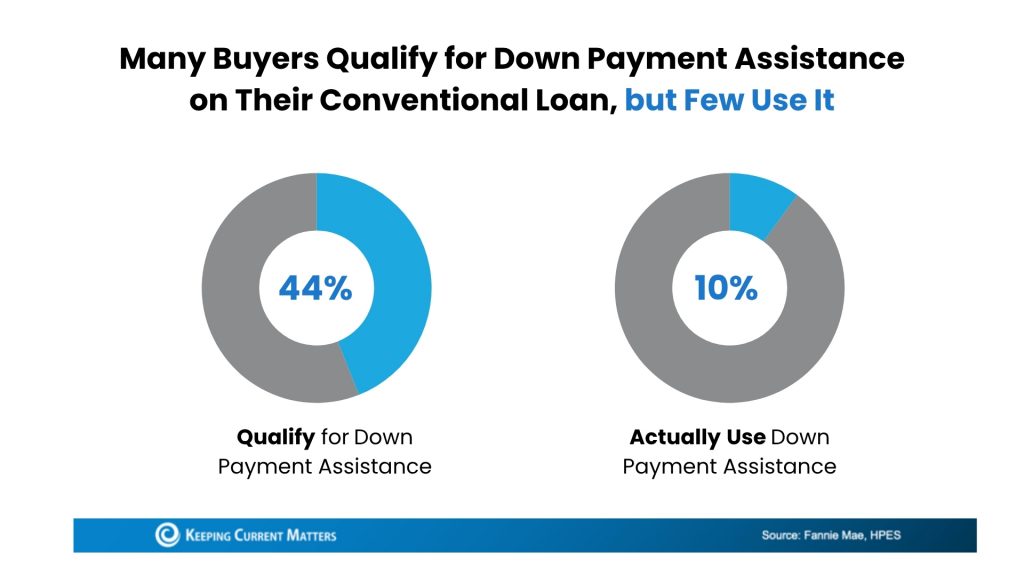
Down payment assistance is one of the most overlooked tools out there. Looking at the 10 largest U.S. metros, Urban Institute and Down Payment Resource found nearly 44% of recent buyers already qualified for a down payment program, but many of them closed on their loan without tapping the help (see chart):
The options are broader than you might assume, too. According to Down Payment Resource:

  • There are more than 2,600 down payment assistance programs available.
  • More than half (62%) are designed to help first-time buyers.
  • 38% have no first-time buyer requirement, so you may qualify even if you’ve owned before.
  • 62% are open to buyers earning $100,000 or more.

This may surprise you, but many home buyers never learn they qualify for down payment assistance. One of the biggest reasons is economics. Identifying and originating these loans often creates additional work and lower profitability for mortgage companies.

They frequently involve:

  • Researching multiple assistance programs to determine borrower eligibility
  • Verifying program-specific income, property, and eligibility requirements
  • Collecting additional borrower documentation
  • Completing a second underwriting or approval process through a housing finance agency or program administrator
  • Preparing additional disclosures and compliance documentation
  • Coordinating with state or local housing agencies
  • Preparing additional closing documents
  • Completing additional post-closing reporting and documentation requirements

All of this requires additional time from the loan officer, processor, underwriter, closer, and post-closing staff.

At the same time, many down payment assistance loans are less profitable for the mortgage company. Depending on the program, lenders may receive lower premiums when selling the loan on the secondary market, face limits on the fees they can charge, and incur higher operating costs because of the additional processing and compliance requirements. In some mortgage companies, loan officers may also receive reduced compensation on certain down payment assistance loans.

The result is simple: many lenders naturally focus on loan products that are easier to originate, require less staff time, and generate higher profitability.

That means thousands of homebuyers never learn they may qualify for grants or assistance that could save them thousands of dollars.

Advantage Home Plus isn’t a lender. Our role is to educate employees, answer their questions, and help them make informed homebuying decisions – including the use of down payment assistance programs when appropriate.

Our goal is to help employees successfully combat the housing affordability crisis by making informed decisions, understanding the options available, and potentially saving money with one of the largest financial decisions of their lives.

If you’re considering buying a home in the next 12 months, it could save you thousands by talking with your Employee Homeownership Advisor first. With the guidance and added help from assistance programs, you may have more ways forward than you realized.


Employee Homeonwrship Program

SupportSquad@AdvantageHomePlus.com | (800)511-2197 

Beyond Interest Rates: How Refinancing Can Lower Your Monthly Stress

Instead of waiting for a "perfect" market that no one can predict, June offers a unique opportunity to evaluate how your home’s equity can be used as a tool to streamline your budget and provide immediate relief to your monthly cash flow.
 “Is my current mortgage structure helping or blocking my overall financial goals?”

As we reach the midpoint of the year, many employees find that their financial priorities have shifted since January. While the national conversation often fixates on when interest rates might drop, a more vital question for your personal wellness is:

 “Is my current mortgage structure helping or blocking my overall financial goals?”

Instead of waiting for a “perfect” market that no one can predict, June offers a unique opportunity to evaluate how your home’s equity can be used as a tool to streamline your budget and provide immediate relief to your monthly cash flow.

For many households, the primary financial challenge isn’t just the mortgage, it’s the accumulation of other, high-interest obligations. Refinancing today can be a powerful move if it allows you to consolidate debt and lower your total monthly out-of-pocket expenses.

“Strategic refinancing isn’t about chasing the lowest rate; it’s about improving your overall financial position and creating breathing room in your monthly budget.”

Even if current mortgage rates are higher than your original loan, a refinance may still make sense if it helps you achieve specific goals:

  • Debt Consolidation: Rolling high-interest credit card debt or personal loans into a single, lower-interest payment.
  • Eliminating PMI: If your home’s value has increased significantly, you may be able to remove private mortgage insurance and lower your monthly cost.
  • Accessing Equity: Using your home’s value for necessary renovations or major upcoming life expenses without taking out high-interest personal loans.
  • Repositioning for Flexibility: Adjusting your loan terms to better align with your long-term retirement or savings plans.

The “wait and see” approach often results in carrying expensive debt longer than necessary. By shifting your focus from “market timing” to “financial strategy”, you can make progress now and still have the option to adjust your loan again if rates improve in the future.

To help you determine if the math works in your favor, your company provides a homeownership benefit focused on clear, objective education. This resource allows you to compare different financing scenarios and identify where you can save the most money based on your unique situation.

Your Employee Homeownership Program is here to help you plan, navigate your options, and save money along the way.

Book a Strategy Session to get a clear, personalized path forward – based on your unique situation.

Employee Homeonwrship Program

SupportSquad@AdvantageHomePlus.com | (800)511-2197 

3 Simple Habits to Boost Your Mortgage Readiness This Summer

3 Simple Habits to Boost Your Mortgage Readiness This Summer
June is the perfect time to pull back the curtain on these numbers.

When it comes to financial wellness, few topics carry as much weight, or as much mystery, as the credit score. For many employees dreaming of homeownership, the credit score is often viewed as an intimidating gatekeeper that can feel impossible to satisfy. However, June is the perfect time to pull back the curtain on these numbers.
Understanding how credit works is not just about getting a loan; it is about taking control of your financial reputation and opening doors to long-term wealth that many assume are closed.

A lot of people assume they are not ready to buy because their credit isn’t “perfect,” but homeownership is often closer than most realize. The biggest issue isn’t always the score itself; it’s the lack of a clear plan to manage it.

“Your credit score is a reflection of your financial habits, and like any habit, it can be improved with the right information and consistent effort.”

You don’t need to be a financial expert to start making meaningful progress this month. Focus on these core areas to strengthen your position:

  • Understand Your Utilization: Learning how the balance on your credit cards relative to your limits affects your score.
  • Identify and Dispute Errors: Knowing how to check your credit report for inaccuracies that could be unfairly dragging your score down.
  • Establish Consistency: Understanding why a history of on-time payments is the most significant factor in long-term credit health.

The value of a higher credit score goes far beyond a simple “approval”. In the context of a mortgage, even a slight improvement in your score can lead to lower interest rates, which translates into thousands of dollars saved over the life of your loan.

To help you demystify this process, your employer-sponsored homeownership benefit offers personalized guidance on credit readiness. This is not about “quick fixes”; it is about professional education and building a step-by-step path tailored to your unique goals.

Your Employee Homeownership Program is here to help you plan, navigate your options, and save money along the way.   Book a Strategy Session to get a clear, personalized path forward – based on your unique situation.

Employee Homeonwrship Program

SupportSquad@AdvantageHomePlus.com | (800)511-2197 

Por qué tantas personas están comprando su primera casa a los 40 años

Buying your first home in your 40s is the new normal, and a smart financial move.
La edad promedio de quienes compran casa por primera vez está aumentando. Descubre por qué comprar a los 40 años es más común que nunca y cómo comenzar tu camino hoy mismo

Durante décadas, comprar tu primera casa a los 20 o a principios de los 30 años se consideraba la norma. Hoy en día, esa ya no es la realidad.

De hecho, la edad promedio de un comprador de vivienda por primera vez se ha desplazado cerca de los 40 años – un reflejo de cuánto ha cambiado el mercado inmobiliario y la vida financiera.

Si alguna vez has sentido que vas “atrasado” en lo que respecta a ser dueño de una casa, no eres el único. Y lo más importante: no es demasiado tarde.

Varios factores han remodelado el camino hacia la propiedad de una vivienda:

El aumento en el precio de las casas – los costos de la vivienda en EE. UU. han incrementado más del 100% desde 2005, mientras que los ingresos han crecido mucho más lento:

  • Un mayor costo de vida, lo que hace que sea más difícil ahorrar
  • Deudas estudiantiles y otras prioridades financieras que compiten entre sí
  • Tiempos de vida cambiantes, incluyendo decisiones de carrera y familia más tardías

¿El resultado? Muchas personas no renunciaron a ser dueños de una casa – simplemente lo pospusieron.

Aunque comprar más tarde se ha vuelto más común, hay una realidad importante que debemos entender:

El tiempo en el mercado importa.

Muchos de los jubilados de hoy se beneficiaron de décadas de propiedad de vivienda – lo que permitió que el valor de su casa creciera significativamente con el tiempo, convirtiéndose a menudo en uno de sus activos financieros más grandes.

  • Cuando la compra de una vivienda se retrasa:
  • Hay menos años para la plusvalía
  • Hay menos tiempo para construir capital (equity)

Existe una mayor probabilidad de seguir pagando una hipoteca durante la jubilación

Esto no significa que debas apresurarte a comprar – pero sí significa que tener un plan lo antes posible puede marcar una diferencia significativa con el tiempo.

Muchas personas asumen que no están listas para comprar porque piensan:

  • “No tengo suficiente ahorrado”
  • “Necesito el 20% de pago inicial”
  • “Mi crédito no es lo suficientemente bueno”

En realidad, muchas personas se descalifican a sí mismas antes de explorar sus opciones. El problema principal no siempre son las finanzas – es no saber qué es lo que realmente es posible.

Hoy en día existen más caminos hacia la propiedad de una vivienda de lo que la mayoría espera, incluyendo:

  • Opciones de préstamos con bajo pago inicial
  • Programas de asistencia para el pago inicial que pueden reducir significativamente los costos iniciales
  • Guía para mejorar el crédito y prepararse financieramente

Para ayudarte a planificar, navegar tus opciones y ahorrar dinero en el proceso, tu empresa ha puesto a tu disposición un beneficio de vivienda.

Tu Programa de Vivienda para Empleados está diseñado para simplificar el proceso y darte un camino claro a seguir, ayudándote a:

  • Entender dónde estás parado hoy – en términos financieros y de crédito
  • Explorar opciones de préstamos y asistencia para el pago inicial que tal vez no sabías que existían
  • Crear un plan personalizado basado en tus metas y tiempos
  • Navegar el proceso con guía experta, para que no tengas que resolverlo todo solo
  • Ahorrar dinero a través de programas disponibles, oportunidades de ahorro y estrategias de financiamiento más inteligentes

Para muchos empleados, este tipo de apoyo es la diferencia entre seguir esperando y realmente avanzar con confianza.

No necesitas tenerlo todo resuelto para comenzar. Solo necesitas claridad sobre lo que es posible para ti. Si ser dueño de una casa es algo en lo que has estado pensando, tu Programa de Vivienda para Empleados ofrece un primer paso sencillo:

Una Sesión de Estrategia personalizada donde puedes:

  • Hacer preguntas
  • Explorar tus opciones
  • Construir un plan que se adapte a tu situación

Sin presiones – solo una comprensión más clara de tu camino a seguir.d. 

Tu Programa de Vivienda para Empleados está aquí para ayudarte a planificar, navegar tus opciones y ahorrar dinero en el proceso.

Reserva una Sesión de Estrategia para obtener un camino claro y personalizado hacia adelante, basado en tu situación única.d on your unique situation. 

Employee Homeonwrship Program

SupportSquad@AdvantageHomePlus.com | (800)511-2197 

¿Esperando a que bajen las tasas? Lo que la mayoría de los propietarios se equivoca sobre el refinanciamiento

Moving beyond "waiting for rates to drop" and focusing on a long-term financial strategy.

Si has pensado en refinanciar tu casa, es muy probable que también hayas pensado:

“Esperaré hasta que las tasas bajen”.

No eres el único. En todo el país, muchos propietarios están esperando -con la esperanza de encontrar el momento “perfecto” para refinanciar-. Pero esto es lo que la mayoría de la gente no nota:

Esperar sin un plan puede costar más que actuar de manera estratégica.

En principio, tiene sentido:

  • Las tasas de interés actuales son más altas que las de hace apenas unos años.
  • Millones de propietarios aseguraron tasas históricamente bajas.
  • La idea de refinanciar a una tasa más alta se siente como un paso atrás.

Por lo tanto, la decisión por defecto suele ser: no hacer nada por ahora.

El desafío es que el refinanciamiento no se trata solo de obtener la tasa más baja posible. Se trata de mejorar tu situación financiera general.

Y en muchos casos, esperar puede significar:

  • Perder oportunidades para reducir los gastos mensuales.
  • Cargar con deudas de intereses más altos por más tiempo del necesario.
  • Retrasar mejoras financieras que podrían realizarse hoy mismo.

La realidad es que muy pocas personas logran “atinarle al mercado” a la perfección.

Refinanciar hoy en día aún puede tener sentido – dependiendo de tus objetivos -. No existe una solución única para todos, pero puede valer la cual explorar si buscas:

  • Reducir tus obligaciones financieras mensuales totales.
  • Consolidar deudas con intereses más altos (como tarjetas de crédito o préstamos personales).
  • Eliminar el seguro hipotecario.
  • Acceder a tu capital acumulado (equity) para necesidades financieras importantes.
  • Reposicionar tu préstamo para tener mayor flexibilidad a largo plazo.

La clave está en entender si alguna de estas opciones aplica a tu situación.

En lugar de preguntar: “¿Cuándo bajarán las tasas?”, una pregunta más útil es: “¿Hay alguna manera de mejorar mi situación ahora y ajustarla más adelante si es necesario?”.

Algunos propietarios eligen refinanciar estratégicamente hoy, con la opción de volver a hacerlo en el futuro si las tasas mejoran. Este enfoque se centra en el progreso, no en la perfección.

Para ayudarte a tomar decisiones informadas e identificar oportunidades de ahorro, cuentas con un beneficio de vivienda diseñado para apoyarte.

Tu Programa de Vivienda para Empleados puede ayudarte a:

  • Evaluar si refinanciar tiene sentido para tu situación actual.
  • Identificar oportunidades para bajar tus pagos mensuales o reducir deudas.
  • Entender cómo utilizar el capital de tu casa (equity) de manera estratégica.
  • Comparar diferentes opciones de préstamos basadas en tus metas.
  • Ahorrar dinero mediante estrategias de financiamiento más inteligentes, descuentos de prestamistas y programas disponibles.  

Para muchos empleados, este tipo de orientación ayuda a descubrir oportunidades que no sabían que estaban disponibles.

Refinanciar puede parecer complejo, especialmente con los cambios en las tasas y la incertidumbre del mercado. Pero no necesitas tener todas las respuestas antes de explorar tus opciones.

Tu Programa de Vivienda para Empleados ofrece un primer paso sencillo: una Sesión de Estrategia personalizada donde puedes:

  • Revisar tu hipoteca actual y tus metas financieras.
  • Explorar diferentes escenarios de refinanciamiento.
  • Obtener recomendaciones claras y personalizadas.

Sin presiones – solo una mejor comprensión de lo que es posible para ti.

Tu Programa de Vivienda para Empleados está aquí para ayudarte a planificar con anticipación, evaluar tus opciones y ahorrar dinero donde tenga sentido hacerlo.

Reserva una Sesión de Estrategia para explorar si el refinanciamiento podría mejorar tu situación financiera, ya sea ahora o en el futuro.

Employee Homeonwrship Program

SupportSquad@AdvantageHomePlus.com | (800)511-2197 

La razón real por la que los propietarios no están vendiendo ahora mismo

Moving forward with confidence starts with having a clear plan for what comes after the sale.

Para muchos propietarios hoy en día, la decisión de vender no es tan sencilla como solía ser. No es que la gente no quiera mudarse.

Es que no están seguros de qué pasará después de hacerlo.

Si has pensado en vender tu casa -pero no has dado el siguiente paso- no eres el único.

En el mercado actual, los propietarios se enfrentan a una situación única:

  • Muchos han asegurado tasas de interés históricamente bajas; un gran porcentaje tiene tasas hipotecarias por debajo del 4%
  • El valor de las viviendas ha aumentado, creando un capital (equity) significativo

Pero comprar otra casa a menudo significa pagos mensuales más altos, incluso para una propiedad de precio similar.

Esto crea la sensación de estar atrapado – algo que comúnmente se conoce como “esposas de oro”. Puede que tengas una excelente casa… pero no la casa adecuada para tus necesidades actuales. En muchos casos, los propietarios conservan sus tasas bajas – pero también se quedan en hogares que ya no se adaptan a sus vidas.

En todo el país, esta duda se está reflejando en el mercado. El inventario de viviendas sigue siendo más bajo de lo normal, en gran parte porque muchos propietarios prefieren quedarse donde están antes que renunciar a su tasa hipotecaria actual.

Al mismo tiempo, la demanda de los compradores sigue siendo fuerte – especialmente durante los meses de primavera y verano.

¿El resultado?

Muchos propietarios cuentan con un capital valioso – pero retrasan sus decisiones porque no tienen un plan claro sobre qué sigue después.

La mayoría de los propietarios no dudan en vender porque no puedan hacerlo. Dudan porque no tienen respuestas claras a preguntas como:

  • Si vendo, ¿a dónde me mudo después?
  • ¿Puedo comprar antes de vender?
  • ¿Podré permitirme mi próxima casa?
  • ¿Qué pasa si los tiempos no coinciden?

Sin claridad, es fácil quedarse donde estás – incluso si ese lugar ya no es el adecuado para ti.

El mercado actual requiere un enfoque diferente al del pasado. Aunque las condiciones han cambiado, también lo han hecho las estrategias disponibles para los propietarios. Existen opciones de las que muchos vendedores no están al tanto, incluyendo:

  • Comprar tu próxima casa antes de vender la actual
  • Soluciones puente que ayudan con los tiempos y el flujo de caja
  • Opciones de cierre flexible o de alquiler posterior (rent-back)
  • El uso estratégico de tu capital acumulado (equity)

El desafío no es la falta de oportunidades – es la falta de visibilidad sobre estas opciones.

Para ayudarte a planificar tu próximo movimiento y aprovechar al máximo el capital de tu vivienda, tu empresa ofrece un beneficio de vivienda diseñado para guiarte tanto en la compra como en la venta.

Tu Programa de Vivienda para Empleados puede ayudarte a:

  • Evaluar el valor actual de tu casa y tu posición de capital (equity)
  • Entender qué puedes permitirte de manera realista para tu próxima casa
  • Explorar estrategias para comprar y vender sin estrés innecesario o empalmes
  • Coordinar los tiempos para que no te quedes sin un lugar donde vivir
  • Ahorrar dinero a través de oportunidades de ahorro y guía experta durante todo el proceso
  • Además, hay aún más beneficios para posibles vendedores, diseñados para ayudarte a maximizar tus ganancias mientras reduces tus costos de venta

Para muchos propietarios, este tipo de apoyo convierte la incertidumbre en un plan claro y manejable.

El mayor error que cometen muchos propietarios es asumir que su situación es demasiado complicada o que deben resolverlo todo por su cuenta. En realidad, contar con el plan adecuado puede abrir puertas que antes no parecían posibles.

Before making any decisions, it helps to understand your options. Tu Programa de Vivienda para Empleados ofrece un primer paso sencillo:

Una Sesión de Estrategia personalizada donde puedes:

  • Hacer preguntas sobre tu situación específica
  • Explorar escenarios de compra y venta
  • Construir un plan que se adapte a tus tiempos y metas financieras

Sin presiones – solo claridad y orientación para ayudarte a tomar decisiones informadas.

Tu Programa de Vivienda para Empleados está aquí para ayudarte a navegar el proceso, entender tus opciones y ahorrar dinero en el camino.

Reserva una Sesión de Estrategia para crear un plan claro para tu próximo movimiento, adaptado a tu situación única.

Employee Homeonwrship Program

SupportSquad@AdvantageHomePlus.com | (800)511-2197 

La razón #1 por la que la gente no compra una casa (Y no es lo que imaginas)

Discover the real requirements for homeownership and how to overcome financial uncertainty when buying your first home.
Si alguna vez has pensado en comprar una casa – pero no has dado el siguiente paso – no eres el único.

La mayoría de las personas asumen que el motivo es financiero.

  • Falta de ahorros.
  • Falta de ingresos.
  • No es el momento adecuado.

Sin embargo, en muchos casos, ese no es realmente el problema.

Para muchos empleados, la mayor barrera para ser dueños de una casa no es el dinero – es no saber dónde están parados.

Preguntas como:

  • ¿Realmente puedo permitirme una casa ahora mismo?
  • ¿Cuánto necesito para el pago inicial?
  • ¿Es mi crédito lo suficientemente bueno?
  • ¿Cómo sería mi pago mensual?

Sin respuestas claras, es fácil asumir que la respuesta es “aún no…” y postergarlo.

Existen algunas creencias que impiden que la gente incluso explore sus opciones:

  • “Necesito el 20% de enganche para comprar una casa”
  • “Mi crédito tiene que ser perfecto”
  • “Necesito ganar mucho más dinero” 

En realidad, muchas de estas suposiciones no son precisas. Y a menudo evitan que las personas se den cuenta de lo que realmente es posible.

Estar listo para una hipoteca no se trata de ser perfecto – se trata de estar informado.

Estar preparado simplemente significa:

  • Entender tu situación financiera actual
  • Conocer qué opciones tienes disponibles
  • Tener un plan para seguir adelante – ya sea ahora o más adelante

Para algunas personas, ese plan les permite comprar antes de lo esperado. Para otras, crea un camino claro para lograrlo con el tiempo.

Hoy en día existen más herramientas y recursos disponibles de los que la mayoría conoce, incluyendo:

  • Opciones de pago inicial bajo
  • Programas de asistencia para el pago inicial que pueden reducir los costos iniciales
  • Programas de préstamos flexibles diseñados para una variedad de situaciones financieras
  • Guía para mejorar el crédito y la preparación financiera

Para ayudarte a entender estas opciones y prepararte con confianza, tu empresa ha puesto a tu disposición un beneficio de vivienda.

Tu Programa de Vivienda para Empleados está diseñado para eliminar las suposiciones del proceso y construir un plan claro y personalizado.

A través del programa, puedes:

  • Entender dónde estás parado hoy – en términos financieros y de crédito
  • Conocer para qué podrías calificar actualmente
  • Explorar opciones de préstamos y asistencia para el pago inicial
  • Crear un plan paso a paso basado en tus metas
  • Ahorrar dinero al identificar oportunidades de ahorro y programas disponibles

Para muchos empleados, esto convierte el comprar una casa de una meta imprecisa en un plan real y alcanzable.

La idea errónea más común sobre la compra de una vivienda es que necesitas tener todo resuelto antes de empezar.

En realidad, la mayoría de las personas comienzan con preguntas – no con respuestas.

Y es precisamente ahí donde contar con la guía adecuada marca la mayor diferencia.

Si tienes curiosidad sobre la compra de una vivienda -pero no estás seguro de si estás listo- el mejor primer paso no es adivinar.

Es obtener claridad.

Una Sesión de Estrategia personalizada donde puedes:

  • Hacer preguntas sobre tu situación
  • Entender tus opciones
  • Construir un plan que se adapte a tus tiempos
  • Sin presiones – solo un camino claro e informado hacia adelante.

Tu Programa de Vivienda para Empleados está aquí para ayudarte a planificar, prepararte y ahorrar dinero en el proceso.

Reserva una Sesión de Estrategia para ver dónde estás parado y qué pasos puedes dar a continuación – basándote en tus metas únicas.

Employee Homeonwrship Program

SupportSquad@AdvantageHomePlus.com | (800)511-2197 

Waiting for Rates to Drop? Here’s What Most Homeowners Get Wrong About Refinancing 

Moving beyond "waiting for rates to drop" and focusing on a long-term financial strategy.

If you’ve thought about refinancing your home, there’s a good chance you’ve also thought: 

“I’ll wait until rates drop.” 

You’re not alone. Across the country, many homeowners are holding off – hoping for the “perfect” time to refinance. But here’s what most people don’t realize: 

Waiting without a plan can cost more than acting strategically. 

It makes sense on the surface.  

  • Interest rates today are higher than they were just a few years ago 
  • Millions of homeowners locked in historically low rates  
  • The idea of refinancing into a higher rate feels like a step backward  

So the default decision becomes: do nothing for now. 

The challenge is that refinancing isn’t just about getting the lowest possible rate. It’s about improving your overall financial situation. 

And in many cases, waiting can mean: 

  • Missing opportunities to reduce monthly expenses  
  • Carrying higher-interest debt longer than necessary  
  • Delaying financial improvements that could be made today  

The reality is, very few people successfully “time the market” perfectly.

Refinancing today can still make sense – depending on your goals. It’s not one-size-fits-all, but it may be worth exploring if you want to: 

  • Lower your total monthly financial obligations  
  • Consolidate higher-interest debt (like credit cards or personal loans)  
  • Remove mortgage insurance  
  • Access equity for important financial needs  
  • Reposition your loan for long-term flexibility   

The key is understanding whether any of these apply to your situation. 

Instead of asking: “When will rates drop?” 

A more useful question is: “Is there a way to improve my situation now and adjust later if needed?” 

Some homeowners choose to refinance strategically today, with the option to refinance again in the future if rates improve. This approach focuses on progress, not perfection. 

To help you make informed decisions and identify opportunities to save money, you have a homeownership benefit designed to support you. 

Your Employee Homeownership Program can help you: 

  • Evaluate whether refinancing makes sense for your situation  
  • Identify opportunities to lower monthly payments or reduce debt  
  • Understand how to use your home equity strategically  
  • Compare different loan options based on your goals  
  • Save money through smarter financing strategies, lender discounts and available programs  

For many employees, this kind of guidance helps uncover opportunities they didn’t realize were available. 

Refinancing can feel complex, especially with changing rates and market uncertainty. 

But you don’t need to have all the answers before exploring your options. 

Your Employee Homeownership Program offers a simple first step – A personalized Strategy Session where you can: 

  • Review your current mortgage and financial goals  
  • Explore refinancing scenarios  
  • Get clear, personalized recommendations  

No pressure – just a better understanding of what’s possible. 

Your Employee Homeownership Program is here to help you plan ahead, evaluate your options, and save money where it makes sense. 

Book a Strategy Session to explore whether refinancing could improve your financial situation – now or in the future. 

Employee Homeonwrship Program

SupportSquad@AdvantageHomePlus.com | (800)511-2197 

Why So Many People Are Buying Their First Home in Their 40s 

And What That Means for You 

Buying your first home in your 40s is the new normal, and a smart financial move.
The average age of first-time homebuyers is rising. Discover why buying in your 40s is more common than ever and how to start your journey today.

For decades, buying your first home in your 20s or early 30s was considered the norm. 

Today, that’s no longer the reality. 

In fact, the average age of a first-time homebuyer has shifted closer to 40 years old – a reflection of how much the housing market – and financial life – has changed. 

If you’ve ever felt like you’re “behind” when it comes to homeownership, you’re not alone. And more importantly, you’re not too late. 

Several factors have reshaped the path to homeownership: 

Rising home prices – U.S. housing costs have increased more than 100% since 2005, while incomes have grown far more slowly  

  • Higher cost of living, making it harder to save  
  • Student debt and competing financial priorities  
  • Changing life timelines, including later career and family decisions  

The result? Many people didn’t opt out of homeownership – they simply postponed it. 

While buying later has become more common, there’s an important reality to understand: 

Time in the market matters. 

Many of today’s retirees benefited from decades of homeownership – allowing their home value to grow significantly over time, often becoming one of their largest financial assets. 

When homeownership is delayed: 

  • There are fewer years for appreciation  
  • Less time to build equity  
  • And a greater likelihood of carrying a mortgage later into retirement  

This doesn’t mean you should rush into buying – but it does mean that having a plan sooner can make a meaningful difference over time. 

A lot of people assume they’re not ready to buy because: 

  • “I don’t have enough saved”  
  • “I need 20% down”  
  • “My credit isn’t good enough”  

In reality, many people disqualify themselves before ever exploring their options. The bigger issue isn’t always finances – it’s not knowing what’s actually possible. 

There are more pathways to homeownership today than most people expect, including: 

  • Low down payment loan options  
  • Down payment assistance programs that can significantly reduce upfront costs  
  • Guidance on improving credit and preparing financially  

To help you plan, navigate your options, and save money along the way, your company has made a homeownership benefit available to you. 

Your Employee Homeownership Program is designed to simplify the process and give you a clear path forward by helping you: 

  • Understand where you stand today – financially and credit-wise  
  • Explore down payment assistance and loan options you may not know exist  
  • Create a personalized plan based on your goals and timeline  
  • Navigate the process with expert guidance, so you don’t have to figure it out alone  
  • Save money through available programs, cost-saving opportunities, and smarter financing strategies  

For many employees, this kind of support is the difference between continuing to wait and actually moving forward with confidence.

You don’t need to have everything figured out to begin. 

You just need clarity on what’s possible for you

If homeownership is something you’ve been thinking about, your Employee Homeownership Program offers a simple first step: 

A personalized Strategy Session where you can: 

  • Ask questions  
  • Explore your options  
  • Build a plan that fits your situation  

No pressure – just a clearer understanding of your path forward. 

Your Employee Homeownership Program is here to help you plan, navigate your options, and save money along the way. 

Book a Strategy Session to get a clear, personalized path forward – based on your unique situation. 

Employee Homeonwrship Program

SupportSquad@AdvantageHomePlus.com | (800)511-2197 

The Real Reason Homeowners Aren’t Selling Right Now

Moving forward with confidence starts with having a clear plan for what comes after the sale.

For many homeowners today, the decision to sell isn’t as straightforward as it used to be. It’s not that people don’t want to move. 
It’s that they’re unsure what happens after they do. 

If you’ve thought about selling your home – but haven’t taken the next step – you’re not alone. 

In today’s market, homeowners are facing a unique situation: 

  • Many have locked in historically low interest rates, with a large percentage of homeowners holding mortgage rates below 4%  
  • Home values have increased, creating significant equity  

But buying another home often means higher monthly payments, even for a similar-priced home. 

This creates a feeling of being stuck – commonly referred to as “golden handcuffs.” You may have a great home… but not the right home for your current needs. In many cases, homeowners are holding onto low rates – but also staying in homes that no longer fit their lives. 

Across the country, this hesitation is showing up in the market. Housing inventory remains lower than historical norms, largely because many homeowners are choosing to stay put rather than give up their current mortgage rate. 

At the same time, demand from buyers remains strong – especially during the spring and summer months. 

The result? 

Many homeowners are sitting on valuable equity – but delaying decisions because they don’t have a clear plan for what comes next. 

Most homeowners don’t hesitate to sell because they can’t. They hesitate because they don’t have clear answers to questions like: 

  • If I sell, where do I go next?  
  • Can I buy before I sell?  
  • Will I be able to afford my next home?  
  • What happens if timing doesn’t line up?  

Without clarity, it’s easy to stay where you are – even if it’s no longer the right fit.  

Today’s market requires a different approach than in the past. While conditions have changed, so have the strategies available to homeowners. There are options available that many sellers aren’t aware of, including: 

  • Buying your next home before selling your current one  
  • Bridge solutions that help with timing and cash flow  
  • Flexible closing or rent-back options  
  • Using your existing equity strategically  

The challenge isn’t a lack of opportunity – it’s a lack of visibility into these options. 

To help you plan your next move and make the most of your home equity, your company offers a homeownership benefit designed to guide you through both buying and selling. 

Your Employee Homeownership Program can help you: 

  • Evaluate your current home value and equity position  
  • Understand what you can realistically afford for your next home  
  • Explore strategies to buy and sell without unnecessary stress or overlap  
  • Coordinate timing so you’re not left without a place to live  
  • Save money through cost-saving opportunities and expert guidance throughout the process  
  • Plus, even more benefits for potential home sellers, designed to help you maximize your profits while reducing your costs to sell

For many homeowners, this kind of support turns uncertainty into a clear, manageable plan. . 

The biggest mistake many homeowners make is assuming their situation is too complicated or that they need to figure it out on their own. In reality, having the right plan can open doors that didn’t seem possible before. 

Before making any decisions, it helps to understand your options. Your Employee Homeownership Program offers a simple first step: 

A personalized Strategy Session where you can: 

  • Ask questions about your specific situation  
  • Explore buying and selling scenarios  
  • Build a plan that works for your timeline and financial goals  

No pressure – just clarity and guidance to help you make informed decisions.

Your Employee Homeownership Program is here to help you navigate the process, understand your options, and save money along the way

Book a Strategy Session to create a clear plan for your next move tailored to your unique situation. 

Employee Homeonwrship Program

SupportSquad@AdvantageHomePlus.com | (800)511-2197