Could You Be Missing Out on Thousands in Homebuying Assistance?

Saving for a down payment can feel like the hardest part of buying a home. And with affordability as tight as it’s been lately, it’s fair to wonder how anyone manages it right now. Here’s something you may not have seen coming.

Saving for a down payment can feel like the hardest part of buying a home. And with affordability as tight as it’s been lately, it’s fair to wonder how anyone manages it right now. Here’s something you may not have seen coming.

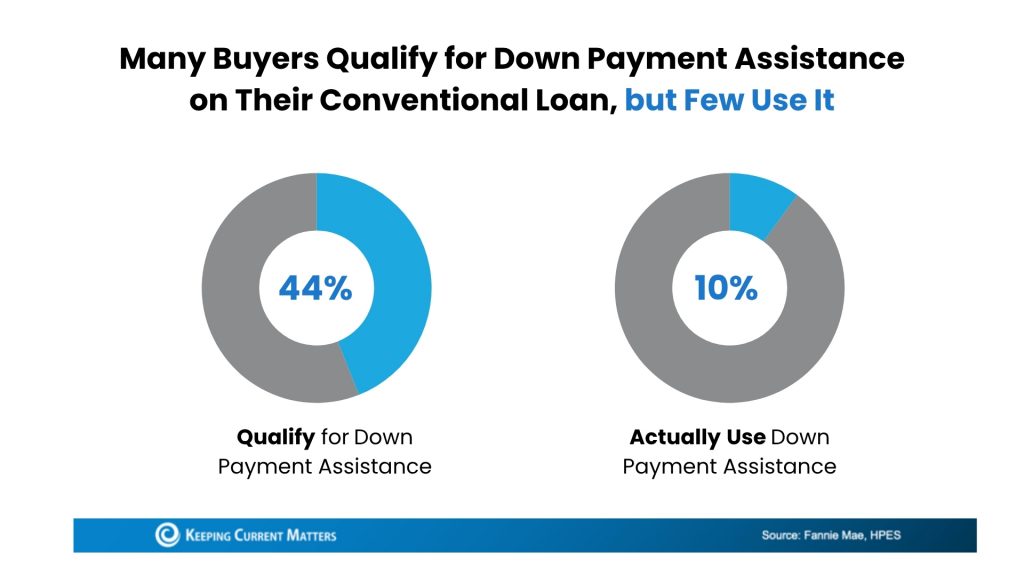
Down payment assistance is one of the most overlooked tools out there. Looking at the 10 largest U.S. metros, Urban Institute and Down Payment Resource found nearly 44% of recent buyers already qualified for a down payment program, but many of them closed on their loan without tapping the help (see chart):
The options are broader than you might assume, too. According to Down Payment Resource:

  • There are more than 2,600 down payment assistance programs available.
  • More than half (62%) are designed to help first-time buyers.
  • 38% have no first-time buyer requirement, so you may qualify even if you’ve owned before.
  • 62% are open to buyers earning $100,000 or more.

This may surprise you, but many home buyers never learn they qualify for down payment assistance. One of the biggest reasons is economics. Identifying and originating these loans often creates additional work and lower profitability for mortgage companies.

They frequently involve:

  • Researching multiple assistance programs to determine borrower eligibility
  • Verifying program-specific income, property, and eligibility requirements
  • Collecting additional borrower documentation
  • Completing a second underwriting or approval process through a housing finance agency or program administrator
  • Preparing additional disclosures and compliance documentation
  • Coordinating with state or local housing agencies
  • Preparing additional closing documents
  • Completing additional post-closing reporting and documentation requirements

All of this requires additional time from the loan officer, processor, underwriter, closer, and post-closing staff.

At the same time, many down payment assistance loans are less profitable for the mortgage company. Depending on the program, lenders may receive lower premiums when selling the loan on the secondary market, face limits on the fees they can charge, and incur higher operating costs because of the additional processing and compliance requirements. In some mortgage companies, loan officers may also receive reduced compensation on certain down payment assistance loans.

The result is simple: many lenders naturally focus on loan products that are easier to originate, require less staff time, and generate higher profitability.

That means thousands of homebuyers never learn they may qualify for grants or assistance that could save them thousands of dollars.

Advantage Home Plus isn’t a lender. Our role is to educate employees, answer their questions, and help them make informed homebuying decisions – including the use of down payment assistance programs when appropriate.

Our goal is to help employees successfully combat the housing affordability crisis by making informed decisions, understanding the options available, and potentially saving money with one of the largest financial decisions of their lives.

If you’re considering buying a home in the next 12 months, it could save you thousands by talking with your Employee Homeownership Advisor first. With the guidance and added help from assistance programs, you may have more ways forward than you realized.


Employee Homeonwrship Program

SupportSquad@AdvantageHomePlus.com | (800)511-2197 

Think Home Prices Will Crash? Here’s What the Experts Actually Expect

¿Qué pasa si esa caída que estás esperando nunca llega?

One of the biggest reasons buyers are still sitting on the sidelines is because they think home prices are going to come down.

  • Some believe a crash is coming and they’ll get a better deal if they hold off.
  • Others worry they’ll buy now and watch their home’s value fall later.

And nobody wants to overpay or buy right before values drop. But here’s the question worth asking:

What if the crash you’re waiting for isn’t actually coming?

Because that’s what the latest data suggests.

If you’ve spent any time online lately, you’ve seen posts claiming home prices are about to come crashing down. And it’s true that some markets are seeing small price declines right now.

But that’s not the same thing as a nationwide crash.

While some places are going through a price adjustment, Realtor.com data shows home prices are still rising in 71% of housing markets across the country. The trouble is, since negative news sells, you’re seeing more coverage about how a handful of markets are seeing declines, than how the majority are still seeing prices rise. And that’s unfortunate.

It’s exactly why a lot of buyers end up with the impression that prices are falling everywhere when they’re not. So how do you really know where prices are really headed from here?

Every quarter, more than 100 economists, housing experts, and market analysts are asked where they think home prices are headed based on the latest data available.

And despite all the uncertainty in today’s market, there’s one thing they largely agreed on:

They don’t think a crash is coming.

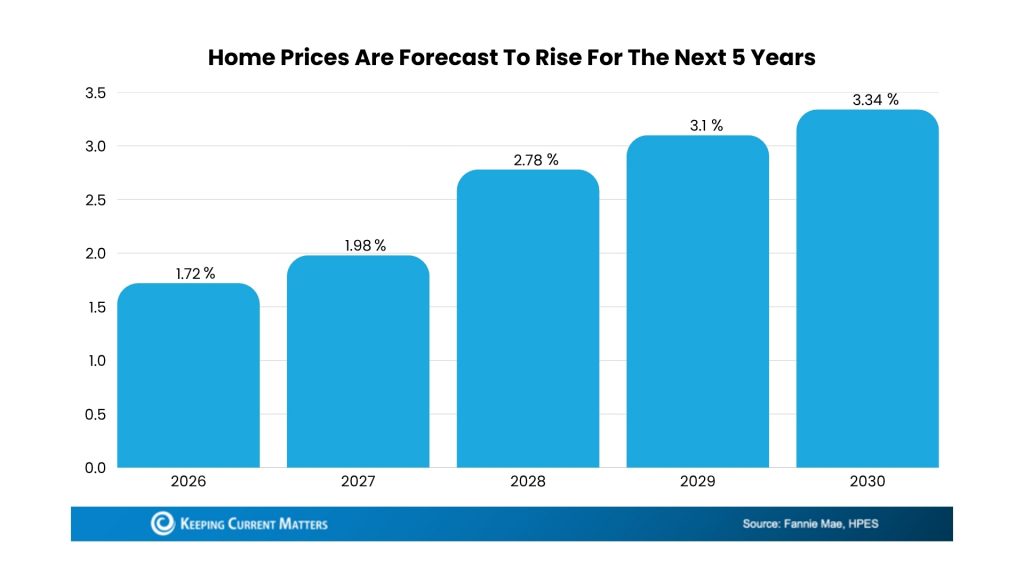
In fact, the average of all their forecasts calls for home prices to rise every year for at least the next 5 years (see graph below):

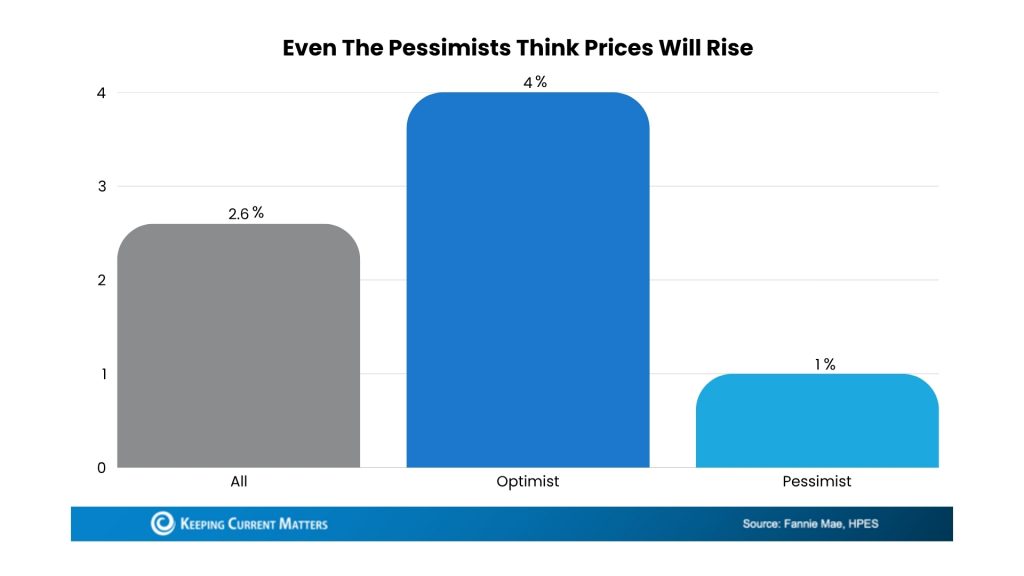
The point is that the overwhelming expectation isn’t for prices to fall. It’s for prices to rise at a more normal pace. And just in case you’re looking at the forecasts and saying: “of course they’d say that” – know that this survey doesn’t just include optimists. It includes pessimists too.

Think about that for a second. The debate among experts isn’t whether prices will crash. It’s how much they’ll rise.

That’s a very different conversation than the one happening across social media.

So, if you’re putting off your move until prices come down, you may be disappointed. According to the experts, a widespread crash isn’t in the cards.

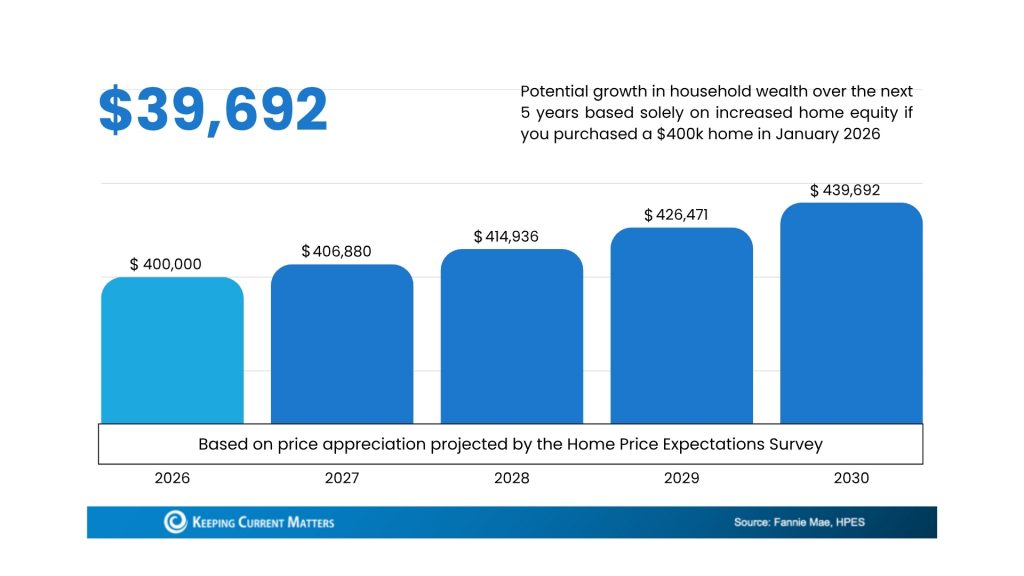
In fact, based on the HPES forecast, a buyer who purchased a $400,000 home this January would gain nearly $40,000 in equity over the next five years from appreciation alone, even in this more moderate market (see below):

Of course, this all depends on local market conditions. This forecast is a national average. But broadly speaking, if the experts are right, the bigger risk isn’t that prices will crash. It may be waiting for a crash that never comes.

Because depending on your market, if you wait, you could be missing out on $40k in equity or paying 40k more in 5 years for the same house.

A lot of buyers are waiting because they think prices will fall, but that’s not what the experts are saying.

If you’re trying to decide whether waiting still makes sense, connect with your Employee Homeownership Program Advisor. They’ll help you understand what’s happening in your local market and what it could mean for your plans.

Employee Homeonwrship Program

SupportSquad@AdvantageHomePlus.com | (800)511-2197 

The “Stay-In-Place” Strategy: Transforming Your Current Home to Fit Your Future

When a household starts outgrowing its layout or notices the decor aging, looking up local property listings feels like the most logical next step.

When a household starts outgrowing its layout or notices the decor aging, looking up local property listings feels like the most logical next step. However, jumping headfirst into a competitive purchasing environment brings a massive wave of logistical friction and lifestyle disruption.
Before committing to a frantic search for a new address, smart financial planning requires exploring what is already right under your feet. July provides an ideal seasonal pause to audit your current environment and uncover hidden spatial potential. Reimagining the square footage you already possess can safeguard your savings while offering profound relief from the claustrophobia of an unoptimized layout.

Deciding to change neighborhoods involves a steep financial toll that goes far beyond the price tag of a new home. Sellers and buyers face thousands of dollars in hidden transactional drains, from real estate commissions and legal fees to moving companies and storage containers. Taking a cold, hard look at your current real estate assets right now shields you from these sunk costs, allowing you to reallocate those exact funds directly into value-boosting property enhancements instead.

“True housing satisfaction rarely requires a brand-new zip code; it stems from intentionally engineering your existing home to generate breathing room for both your family and your wallet.”

Even if current market options seem complex, evaluating the full spectrum of housing costs can help you achieve specific goals:

  • Repositioning for Flexibility: Planning small, phased updates carefully to ensure your home adjustments better align with your long-term retirement or savings plans.
  • Avoiding Moving Friction: Eliminating the thousands of dollars spent on moving logistics and real estate fees, redirecting that capital directly into your home’s value.
  • Maximizing Existing Footprints: Repurposing underutilized areas—like attics, basements, or garages—into functional home offices, gyms, or bedrooms.
  • Locking in Community Value: Preserving your established neighborhood ties, school districts, and commute times while still achieving a “new home” feel.

Falling into the trap of “analysis paralysis” often leads to overcomplicating your finances and stalling your progress altogether. By pivoting your mindset from trying to solve every financial puzzle at once to simply mastering one small habit at a time, you can cut through the noise and build immediate, sustainable momentum.

To help you determine if the math works in your favor, your company provides a homeownership benefit focused on clear, objective education. This resource allows you to compare different financing scenarios, evaluate home equity options for upgrades, and identify where you can save the most money based on your unique situation.

Your Employee Homeownership Program is here to help you plan, navigate your options, and save money along the way.

Book a Strategy Session to get a clear, personalized path forward – based on your unique situation.

Employee Homeonwrship Program

SupportSquad@AdvantageHomePlus.com | (800)511-2197 

Smart Summer Upgrades: How to Build Home Equity with Easy Cosmetic Fixes


Summer is the season of home updates. Whether you are thinking about selling your home in the near future or simply want to build long-term financial stability, you don’t need a massive budget or a full-scale renovation team to make a significant impact.

Many times, the smallest, most manageable cosmetic updates are the ones that yield the highest return on investment. If you are looking for a few productive weekend projects this July, here are the smart, budget-friendly updates that real estate professionals love to see.

First impressions matter immensely. Simple landscaping updates can instantly boost your home’s perceived value. Trim overgrown bushes, edge the lawn, and add a fresh layer of dark mulch to your flower beds. A clean front yard signals that the entire property has been well cared for.

Your front door is the focal point of your home’s exterior. Give it a fresh coat of paint in a classic, appealing color—like deep navy, charcoal, or clean black—and swap out old, tarnished hardware for modern locks. This is one of the lowest-cost projects available, yet it consistently ranks high for visual appeal.

Inside the home, nothing transforms a space faster or more affordable than painting. Focus on high-traffic areas like the entryway or living room. Stick to warm neutrals or off-whites that make spaces feel larger, brighter, and more open.

Old, yellowing light fixtures or outdated cabinet hardware can make a home feel stuck in a different decade. Swapping out old light fixtures for modern LED alternatives and replacing kitchen cabinet knobs with matte black or brushed nickel finishes can make your space feel contemporary without the price tag of a full remodel.

Building equity and maintaining your home is a continuous process. You don’t have to tackle everything at once; progress, not perfection, is what truly makes the difference. If you ever want to know how these updates factor into your home’s overall market value, or if you’re curious about how to leverage your existing equity for your next financial goal, your company-sponsored benefits are always here to guide you.

Your Employee Homeownership Program is here to help you plan, navigate your options, and save money along the way.

Schedule your free consultation today.

Employee Homeonwrship Program

SupportSquad@AdvantageHomePlus.com | (800)511-2197 

Why June is the Strategic Month for Future Homeowners

Moving past the common myth that summer is a "slow" time allows you to gain a significant head start on your homeownership goals while others are distracted by the season.

As the weather warms up and calendars fill with vacations, many people assume the housing market simply hits a “pause” button until the fall. While it’s true that the pace of daily life changes in June, this shift actually creates a unique window of opportunity for employees focused on long-term financial health.

“Moving past the common myth that summer is a “slow” time allows you to gain a significant head start on your homeownership goals while others are distracted by the season.”

The idea that nothing happens in the real estate world during the summer is a misconception. In reality, June is often a time when new inventory stabilizes, giving you a clearer picture of what is available in your price range.

The primary hurdle for many isn’t a lack of homes; it’s a lack of “mortgage confidence.” To build that confidence, you must move from guesswork to facts by evaluating:

  • Your purchasing power: Understanding exactly what you can afford in today’s economic climate.
  • Debt-to-income ratio: Seeing how your current obligations affect your loan potential.
  • Credit health: Identifying small shifts that can lead to better interest rates

This clarity is empowering: it transforms a stressful “what if” into a manageable “when”. Even if you aren’t planning to move until later this year, starting the educational process in June gives you a strategic advantage.

Many employees are surprised to learn about modern pathways to homeownership, such as:

  • Low down payment options: Programs that require much less than the traditional 20%.
  • Down payment assistance: Resources that can bridge the gap between your savings and your dream.
  • Personalized roadmaps: A step-by-step plan based on your unique financial goals.

Many employees are surprised to learn about low down payment options or assistance programs that can bridge the gap between their current savings and their dreams. By taking a moment now to assess your financial standing, you ensure that when the right opportunity appears, you aren’t scrambling to catch up.

To help you navigate these details, your company provides a homeownership benefit focused on education and planning. This resource is designed to help you build a personalized roadmap, identifying potential savings and ensuring you have a clear understanding of your options.

To help you navigate these details, your company provides a homeownership benefit program focused on education and planning. This resource is designed to help you build a plan and identify cost-saving opportunities before you ever sign a contract.

By focusing on financial literacy today, you can enjoy your summer with the peace of mind that comes from having a solid plan in place for your future.

Schedule your free consultation today.

Employee Homeonwrship Program

SupportSquad@AdvantageHomePlus.com | (800)511-2197 

Beyond Interest Rates: How Refinancing Can Lower Your Monthly Stress

Instead of waiting for a "perfect" market that no one can predict, June offers a unique opportunity to evaluate how your home’s equity can be used as a tool to streamline your budget and provide immediate relief to your monthly cash flow.
 “Is my current mortgage structure helping or blocking my overall financial goals?”

As we reach the midpoint of the year, many employees find that their financial priorities have shifted since January. While the national conversation often fixates on when interest rates might drop, a more vital question for your personal wellness is:

 “Is my current mortgage structure helping or blocking my overall financial goals?”

Instead of waiting for a “perfect” market that no one can predict, June offers a unique opportunity to evaluate how your home’s equity can be used as a tool to streamline your budget and provide immediate relief to your monthly cash flow.

For many households, the primary financial challenge isn’t just the mortgage, it’s the accumulation of other, high-interest obligations. Refinancing today can be a powerful move if it allows you to consolidate debt and lower your total monthly out-of-pocket expenses.

“Strategic refinancing isn’t about chasing the lowest rate; it’s about improving your overall financial position and creating breathing room in your monthly budget.”

Even if current mortgage rates are higher than your original loan, a refinance may still make sense if it helps you achieve specific goals:

  • Debt Consolidation: Rolling high-interest credit card debt or personal loans into a single, lower-interest payment.
  • Eliminating PMI: If your home’s value has increased significantly, you may be able to remove private mortgage insurance and lower your monthly cost.
  • Accessing Equity: Using your home’s value for necessary renovations or major upcoming life expenses without taking out high-interest personal loans.
  • Repositioning for Flexibility: Adjusting your loan terms to better align with your long-term retirement or savings plans.

The “wait and see” approach often results in carrying expensive debt longer than necessary. By shifting your focus from “market timing” to “financial strategy”, you can make progress now and still have the option to adjust your loan again if rates improve in the future.

To help you determine if the math works in your favor, your company provides a homeownership benefit focused on clear, objective education. This resource allows you to compare different financing scenarios and identify where you can save the most money based on your unique situation.

Your Employee Homeownership Program is here to help you plan, navigate your options, and save money along the way.

Book a Strategy Session to get a clear, personalized path forward – based on your unique situation.

Employee Homeonwrship Program

SupportSquad@AdvantageHomePlus.com | (800)511-2197 

Condo vs. Single-Family Home: Which to Choose?

A modern condominium building with landscaped grounds and shared amenities like a pool and fitness center. A single-family home with a private yard, driveway, and mature trees showing the space and autonomy of house living.

Choosing between a condo and a single-family home is one of the biggest decisions you’ll make as a homebuyer. Each offers distinct advantages, and the right choice depends on your lifestyle, financial goals, and how you want to spend your time. Understanding the key differences helps you make a decision you’ll feel good about long after closing.

A single-family home puts you in charge of everything. You’re responsible for the roof, the yard, the driveway, and every repair that comes up. For some homeowners, this autonomy is part of the appeal. For others, it’s a time-consuming responsibility.

Condos, by contrast, offer low-maintenance living. The homeowners association (HOA) typically handles exterior maintenance, landscaping, and common areas. You may also have access to amenities like a pool, fitness center, or community room. The trade-off? You pay monthly HOA fees and have less control over shared spaces and exterior decisions.

While condos often have a lower purchase price than single-family homes in the same area, it’s important to look beyond the mortgage. HOA fees can add several hundred dollars to your monthly housing cost. On a single-family home, you’ll need to budget separately for maintenance and repairs typically 1-2% of the home’s value annually.

Consider your total monthly housing cost, including mortgage, taxes, insurance, HOA fees (if applicable), and a maintenance reserve. Understanding the full picture helps you compare apples to apples.

Single-family homes generally offer more privacy and personal outdoor space. You have your own yard, no shared walls, and the freedom to make exterior changes (within local regulations). This is especially appealing for those with children, pets, or a love of gardening.

Condos may involve shared walls, ceilings, or floors. Outdoor space might be a balcony or patio rather than a yard. For many buyers, the trade-off is worth it for the convenience and community feel.

Living in a condo means following HOA rules which can govern everything from pet policies to paint colors to when you can use shared amenities. Some buyers appreciate the structure and consistency; others prefer the autonomy of a single-family home, where restrictions are generally limited to local zoning laws.

Both condos and single-family homes can appreciate, but market dynamics differ. Single-family homes often appeal to a broader range of buyers, including families. Condos may be more sensitive to local market conditions, including new construction and changes in investor demand.

Your timeline matters too. If you plan to stay for many years, either option can be a solid investment. If you expect to move within a few years, consider the liquidity of each property type in your market.

The right choice isn’t about what’s “better” in general, it’s about what fits your life. Ask yourself:

  • How much time do I want to spend on maintenance?
  • Do I value privacy or community amenities?
  • What does my total monthly budget look like with HOA fees or maintenance reserves?
  • How long do I plan to stay?

Answering these questions honestly helps you choose a home that supports your lifestyle and financial goals.

Understanding your options is the first step. The educational resources available through your employer’s financial wellness benefit, with support from a trusted partner like Advantage Home Plus, can help you explore what makes sense for your unique situation.

Por Qué Cada Vez Más Propietarios De Viviendas Deciden Mudarse, Incluso Con Una Tasa Hipotecaria Baja

Si eres propietario de una vivienda con una tasa hipotecaria cercana al 3%, probablemente hayas pensado: 

“Me gustaría mudarme… pero no quiero renunciar a mi tasa” 

Es comprensible. Conseguir una tasa históricamente baja fue una victoria financiera. 

Pero aquí está la pregunta más importante: ¿Es suficiente una excelente tasa para quedarse en una casa que ya no se adapta a tu estilo de vida? Cada vez más propietarios deciden que no.

Durante los últimos años, muchos propietarios retrasaron su mudanza debido al efecto de encierro: quedarse en el mismo lugar para evitar una tasa más alta. 

Según la Agencia Federal de Financiamiento de Viviendas (FHFA), este efecto está comenzando a disminuir. La proporción de propietarios con tasas inferiores al 3% está disminuyendo gradualmente, mientras que las hipotecas superiores al 6% han alcanzado su máximo en 10 años.

En resumen, cada vez más propietarios se están adaptando a las tasas actuales como la nueva normalidad. 

Porque la vida no se detiene por las tasas de interés. Como explica Chen Zhao, director de Investigación Económica de Redfin: 

“La vida no se detiene: la gente consigue nuevos trabajos, amplía sus familias, reduce su tamaño después de la jubilación o simplemente quiere vivir en un barrio diferente”.

First American se refiere a estos motivadores de vida como las “5 D”: 

  • Diplomas – Crecimiento profesional 
  • Pañales – Familias en crecimiento 
  • Divorcio – Transiciones en la vida 
  • Reducción de tamaño – Simplificación 
  • Muerte – Acercamiento a seres queridos 

Realtor.com informa que casi dos de cada tres posibles vendedores llevan más de un año pensando en mudarse. Es mucho tiempo para retrasar cambios importantes en la vida. 

Si bien la tasa de interés es importante, es solo una parte de la decisión.

Otros factores pueden influir en su mudanza:

  • Capital acumulado en la vivienda
  • Aumento de los ingresos familiares
  • Mejoras en el estilo de vida
  • Situación financiera a largo plazo

Las tasas hipotecarias ya han bajado desde su máximo reciente y se prevé que disminuyan ligeramente en 2026. La verdadera pregunta puede que no sea “¿Debería renunciar a mi tasa baja?“, sino “¿Mi casa actual todavía se adapta a mi estilo de vida?“.

Mudarse en el mercado actual requiere coordinación. Es posible que deba evaluar:

  • Su situación actual de capital
  • Vender primero vs. comprar primero
  • Nuevos escenarios de pagos mensuales
  • Tiempo entre transacciones

A través de su Programa de Vivienda para Empleados, tiene acceso a sesiones individuales de planificación y estrategia que le ayudarán a:

  • Comparar quedarse vs. Mudarse
  • Evaluar la asequibilidad con las tasas actuales
  • Explorar opciones de comprar antes de vender
  • Identificar posibles oportunidades de ahorro

En lugar de reaccionar emocionalmente a las tasas, puede tomar una decisión basada en su estrategia y objetivos a largo plazo.

Una tasa baja es valiosa, pero también lo es vivir en una casa que le permita vivir hoy. Si ha estado posponiendo una mudanza debido a la tasa de su hipoteca, quizás sea el momento de revisar su situación financiera completa.

Su Programa de Vivienda Propia para Empleados es un recurso confiable para ayudarle a evaluar sus opciones con claridad.

Las Previsiones De Los Expertos Apuntan A Que La Asequibilidad Mejorará En 2026

Si te has estado preguntando qué esperar del mercado inmobiliario en 2026, ¡no eres el único! Durante los últimos años, la asequibilidad ha sido el mayor obstáculo tanto para compradores como para vendedores. Muchas personas han estado a la espera, con la esperanza de que las condiciones mejoraran.

¿La buena noticia? Están mejorando.

De hecho, la asequibilidad en 2025 fue la mejor de los últimos tres años, y los expertos coinciden en que esta tendencia positiva continuará en 2026. Su pronóstico se basa en tres factores clave que influirán en el mercado: las tasas hipotecarias, la oferta de viviendas y los precios de las casas.

Las tasas hipotecarias han bajado desde su pico reciente, casi un punto porcentual en el último año. Este descenso puede parecer modesto, pero puede marcar una diferencia significativa en los pagos mensuales y en el poder adquisitivo general.

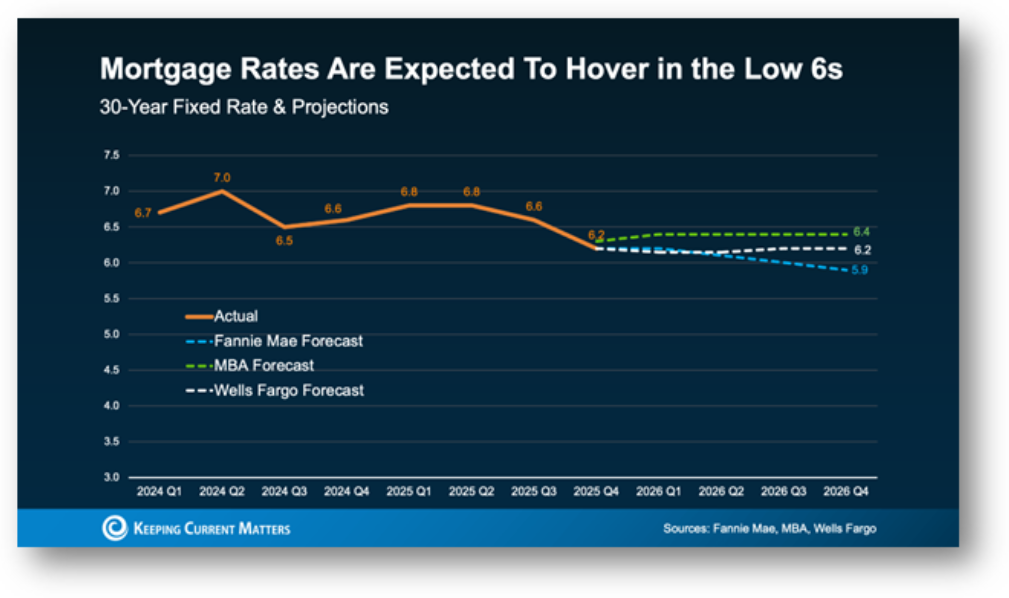
Entonces, ¿qué sucederá con las tasas en el futuro? Las previsiones sugieren que se estabilizarán en gran medida, manteniéndose alrededor del 6% durante todo 2026 (véase el gráfico a continuación).

La evolución de las tasas de interés dependerá de la economía en general, el crecimiento del empleo y las futuras decisiones de la Reserva Federal. Lo más importante es que las tasas ya son más bajas que hace un año, lo que crea mejores condiciones para quienes planean mudarse en 2026.

  • Para los compradores: Las tasas más bajas pueden reducir los pagos mensuales y aumentar el poder adquisitivo.
  • Para los vendedores: Las tasas en torno al 6% podrían ser la nueva normalidad, y muchas mudanzas siguen siendo viables, especialmente con el capital acumulado.

El inventario de viviendas experimentó un avance significativo en 2025, con un aumento de alrededor del 15%. Con la llegada de más viviendas al mercado, los compradores obtuvieron algo que no habían tenido en años: más opciones, más tiempo y mayor poder de negociación. Este cambio contribuyó a restablecer el equilibrio y a frenar el rápido aumento de los precios.

De cara al futuro, los expertos de Realtor.com proyectan que el inventario seguirá mejorando, con un crecimiento previsto del 8,9% (véase el gráfico a continuación).

  • Para los compradores: Más opciones y mayor poder de negociación. 
  • Para los vendedores: Fijar precios estratégicamente será más importante que nunca. 

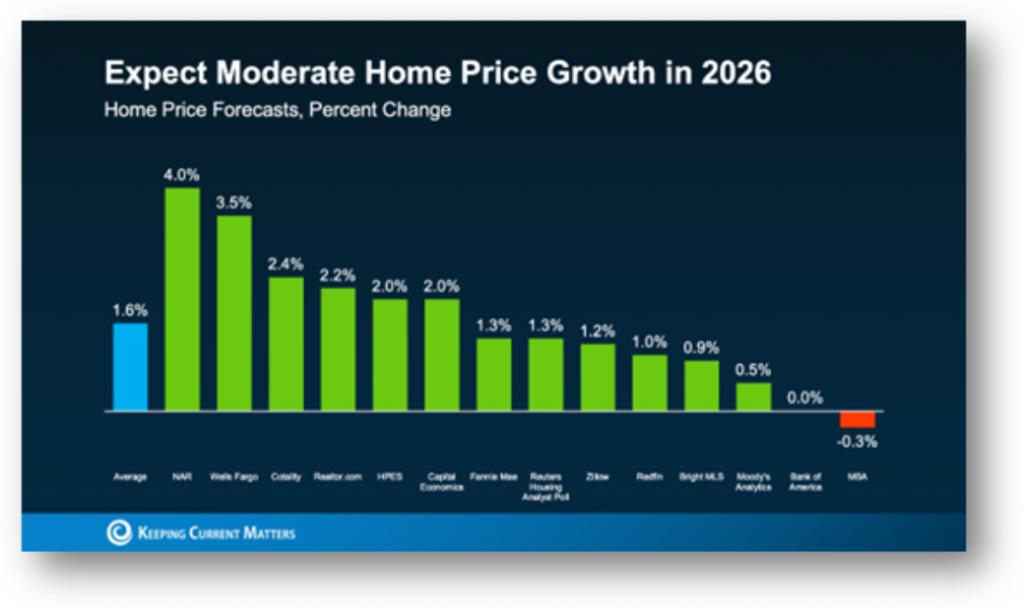
Con la mejora del inventario, la presión sobre los precios ha disminuido. Si bien la mayoría de los expertos coinciden en que los precios de la vivienda seguirán subiendo a nivel nacional en 2026, se espera que el ritmo sea mucho más sostenible. En promedio, se prevé que los precios aumenten alrededor del 1,6% (véase el gráfico a continuación).

Este es un dato importante en medio de las afirmaciones en línea que predicen grandes caídas de precios. Si bien las condiciones variarán según la ubicación (algunos mercados podrían experimentar descensos moderados, otros un crecimiento más fuerte), las perspectivas a nivel nacional se mantienen estables.

“Para compradores y vendedores de viviendas, este cambio indica un mercado más equilibrado, donde el crecimiento de los precios se estabiliza, la reducción de las tasas de interés ofrece un respiro y el poder de negociación se inclina sutilmente hacia los compradores”.

  • Para los compradores: Menos aumentos repentinos de precios significan mayor previsibilidad y una mejor planificación financiera. 
  • Para los vendedores: Un crecimiento más lento ayuda a preservar el valor de la propiedad y contribuye a un mercado más saludable. 

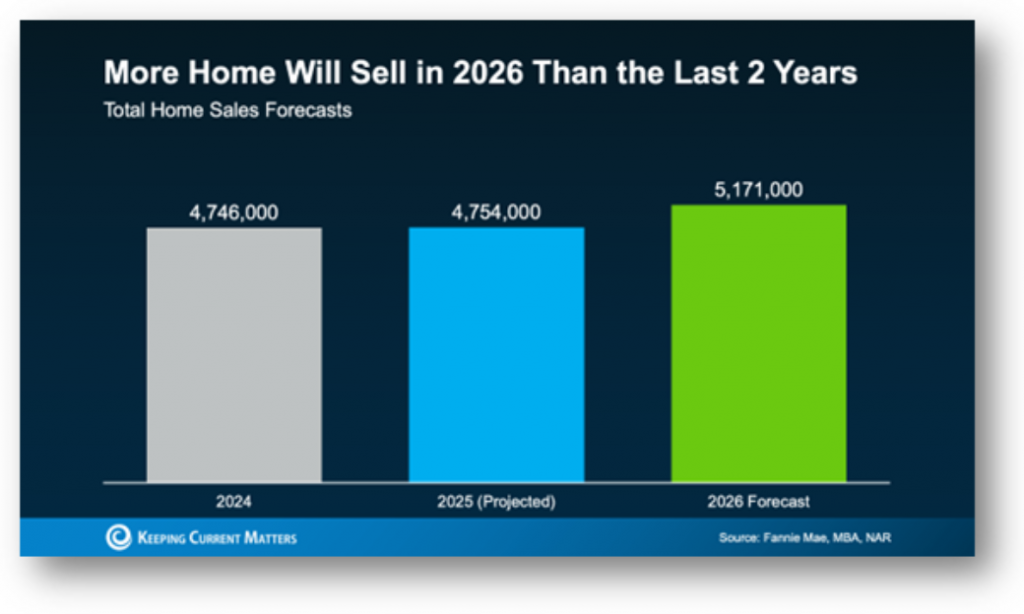
En conjunto, estas tendencias apuntan a una mayor asequibilidad en 2026, y por eso los expertos esperan que se vendan más viviendas el próximo año. 

“Los compradores se benefician de una mayor oferta y una mayor asequibilidad, mientras que los vendedores observan estabilidad de precios y una demanda más constante. Ambos grupos deberían tener un poco más de margen de maniobra en 2026”.

La asequibilidad no cambiará de la noche a la mañana, pero se están logrando avances constantes. Con la estabilización de las tasas hipotecarias, la mejora de la oferta de viviendas y la moderación del aumento de los precios, el mercado inmobiliario de 2026 se perfila como un mercado más equilibrado y predecible que el de los últimos años.

Si desea comprender cómo estas tendencias afectan a su mercado local o explorar las opciones disponibles, su Programa de Adquisición de Vivienda para Empleados está aquí para ayudarle. El programa ofrece asesoramiento, importantes ahorros, formación y apoyo para que pueda tomar decisiones informadas en el momento adecuado.

¿No Estás Seguro De Si Estás Listo Para Comprar Una Casa En 2026? Empieza Con Estas 5 Preguntas

Si estás pensando en comprar una casa el próximo año, probablemente estés considerando muchos factores a la vez: tus finanzas, las tasas hipotecarias actuales, los precios de las viviendas y la posible evolución de la economía. Puede resultar abrumador, sobre todo cuando todo el mundo parece tener una opinión sobre si este es el momento adecuado para comprar.

Aquí está la buena noticia: si bien las condiciones del mercado son importantes, solo son una parte del panorama. Tu preparación personal es igual de importante, y eso es algo que sí puedes controlar.

Si comprar una vivienda está entre tus planes para 2026, estas cinco preguntas pueden ayudarte a decidir si estás realmente preparado y qué pasos debes seguir a continuación. 

Comprar una casa es un compromiso a largo plazo, por lo que tener ingresos estables es un punto de partida importante. Esto no significa que su trabajo tenga que ser perfecto, pero saber que su salario es confiable le brindará tranquilidad al planificar.

Si no está seguro de cómo sus ingresos se traducen en un rango de pagos cómodo, este es un buen momento para detenerse y buscar asesoramiento antes de continuar.

Muchos compradores se sorprenden al descubrir que existe una diferencia entre lo que un prestamista puede aprobar y lo que realmente se ajusta a su presupuesto.

Comprender la capacidad de pago implica considerar:

  • La comodidad del pago mensual
  • Las deudas existentes
  • Otros objetivos financieros que desea proteger

Aquí es donde la planificación personalizada puede ser especialmente útil: analizar las cifras antes de hablar con un prestamista o comenzar la búsqueda de una casa.

Su puntaje crediticio influye significativamente en la tasa de interés y en el costo total del préstamo. Incluso pequeñas mejoras pueden marcar una gran diferencia a largo plazo. Si su crédito aún no está donde le gustaría, eso no significa que comprar una casa sea imposible; simplemente puede significar tomar algunas medidas inteligentes ahora para estar en una mejor posición más adelante este año.

Comprar una casa implica más que solo el pago inicial. Los gastos de cierre, los costos de mudanza y el mantenimiento futuro son factores importantes a considerar.

Según la Asociación Nacional de Agentes Inmobiliarios (NAR), permanecer en una casa durante varios años suele ser clave para que esos costos iniciales valgan la pena. Si planea establecerse en un lugar, comprar una casa puede ser una buena opción, pero es importante analizar primero su situación financiera completa.

Before selecting a real estate agent or lender, it can be helpful to talk with someone whose role is simply toAntes de seleccionar un agente inmobiliario o prestamista, puede ser útil hablar con alguien cuya función sea simplemente ayudarle a planificar, no a vender.

A través de su Programa de Adquisición de Vivienda para Empleados de Advantage Home Plus, usted tiene acceso a:

  • Sesiones individuales de asesoramiento y planificación
  • Revisión de crédito y orientación para mejorarlo
  • Ahorro en los gastos de cierre cuando esté listo para avanzar

Having this kind of support early can help you avoid surprises, make confident decisions, and feel prepared before taking the next step.

Comprar una casa no se trata de encontrar el momento perfecto en el mercado, sino de comprender tus finanzas, tus objetivos y tus opciones.

Si estás considerando seriamente comprar una casa en 2026, hablar con el Programa de Propiedad de Vivienda para Empleados de Advantage Home Plus puede ayudarte a aclarar tus dudas y elaborar un plan, antes de elegir un agente inmobiliario, solicitar un préstamo o hacer una oferta.

SupportSquad@AdvantageHomePlus.com | (800) 511-2197