Your Debt Is Not a Deal Breaker: How to Buy a Home with Student Loans and Car Payments

If you have student loans, a car payment, or both, it’s easy to assume homeownership has to wait. Those monthly payments can make a mortgage feel out of reach and it’s completely normal to wonder if lenders will see your debt and instantly say “no.”

But here’s the truth most people don’t hear enough:

Millions of buyers purchase homes every year while managing the same obligations you are. What matters isn’t being debt-free, it’s understanding how your debt fits into the bigger picture.

Instead of thinking: “I can’t buy a home because of my debt,” shift to: “I can buy a home I just need to understand what’s realistic for me.”

That’s where the Employee Homeownership Program comes in.

Lenders aren’t expecting you to have zero debt. In fact, most buyers don’t.

What lenders evaluate is your Debt-to-Income (DTI) ratio, the percentage of your gross monthly income that goes toward your monthly debts, including your future mortgage.

  • Student loan payments
  • Car payments
  • Credit card minimums
  • Personal loans
  • Your estimated mortgage payment

Your student loans and car payment are just part of this equation not an automatic roadblock. The goal is simply to show that after paying your normal bills, you still have enough room in your budget to comfortably take on a home.

Here’s a general rule of thumb:

  • Below 36% DTI: Strong
  • 37%–43%: Often acceptable, depending on the loan
  • Above 43%: May require additional documentation or creative solutions

But here’s the part many buyers miss:

DTI requirements vary, and some loan programs are more flexible than others.

You might qualify sooner than you think, even with existing debt.

If you feel unsure about your numbers, don’t panic. Improving your financial position is often easier than people expect.

Here are a few high-level examples:

  • Consistent, on-time payments matter: Your history of paying your student loans and car payments on time actually helps demonstrate reliability.
  • You may qualify for loan programs that are friendlier to existing debt: Certain government-backed options offer more flexible DTI limits or consider student loans differently.
  • You don’t always need to pay off debt and sometimes shouldn’t: Reducing a balance by a small amount can help. Paying off a debt entirely might not be necessary. And draining savings to pay something off can sometimes hurt more than it helps.

The key is knowing which move is the right move for you, not guessing.

Understanding how your debt plays into your homebuying plans can feel overwhelming but this is exactly what your Employee Homeownership Program is here for.

During your free financial fitness consultation, we’ll help you:

  • Understand your current DTI and what it actually means
  • See whether you should pay down, pay off, or leave your debts exactly as they are
  • Avoid paying off debt unnecessarily (which many people do)
  • Review your personal budget to find a mortgage payment that fits your lifestyle
  • Understand why lenders sometimes approve buyers for more than they’re comfortable spending
  • Learn whether a lender would approve you now, even with your current debts
  • Build a personalized, realistic homebuying plan designed just for your situation

You don’t need to be debt-free. You don’t need to figure it out alone. And you definitely don’t need to guess what the “right” next step is.

If you’re curious whether your student loans or car payments are really holding you back, schedule your free financial fitness consultation today. We’ll walk through everything together so you can take the next step with clarity and confidence.

SupportSquad@AdvantageHomePlus.com | (800) 511-2197

Is Your Debt-to-Income Ratio Secretly Sabotaging Your Mortgage Application?

Is Your Debt-to-Income Ratio Secretly Sabotaging Your Mortgage Application?

When you’re getting ready to buy a home, it’s natural to focus on the familiar steps: checking your credit score, saving for a down payment, and getting your finances in order. But there’s one important number most people overlook until it causes problems: your debt-to-income ratio, or DTI.

DTI plays a major role in your approval because it helps lenders answer one key question: “How comfortably can you take on a mortgage payment along with everything else in your budget?”

This number doesn’t just affect whether you qualify it also helps ensure that your future mortgage fits your lifestyle, not someone else’s idea of what you “should” afford.

Your DTI compares your monthly debt payments to your gross monthly income. It includes things like:

  • Potential housing costs
  • Credit card minimums
  • Auto loans
  • Student loans
  • Personal loans

A lower DTI generally makes approval easier, but here’s what many people don’t realize:

You do NOT need to be debt-free to buy a home.

Most buyers still carry car loans, student loans, or credit card balances, and that’s completely normal.

In fact, many people assume they must pay off large amounts of debt before applying, when sometimes paying off debt is unnecessary… and sometimes not even helpful.

There are simple ways to strengthen your financial picture, such as:

  • Paying down (not necessarily paying off) revolving credit
  • Avoiding new credit accounts or large purchases
  • Looking at options to reduce monthly debt payments

But the truth is, what works best depends entirely on your unique situation. And guessing is where buyers often go wrong, either doing too much or not doing the right things.

Understanding your debt-to-income ratio can feel confusing, but this is exactly where your Employee Homeownership Program comes in.

During your free financial fitness consultation, we’ll help you:

  • Understand your current DTI and what it means
  • See whether you should pay down, pay off, or leave your debts exactly as they are
  • Avoid paying off debt unnecessarily
  • Explore how your personal budget and lifestyle preferences impact the monthly payment you’ll actually feel good about
  • See whether a lender would approve you now, even if you still have debt
  • Get a realistic, personalized homebuying plan that fits your goals

You don’t need to guess. You don’t need to make big financial moves on your own. And you definitely don’t need to be “perfect” to take the next step toward buying a home.

If you’re curious where you stand or want clarity on your DTI, budget, or next steps, schedule your free financial fitness consultation today. We’ll walk through everything together so you can move toward homeownership with confidence.

How to Strengthen Your Pre-Approval Before You Shop

How to Strengthen Your Pre-Approval Before You Shop

A strong pre-approval isn’t about guessing or hoping; it’s about preparation. Here’s where to start:

Before you speak with a lender, collect:

  • Recent pay stubs
  • W-2s
  • Bank statements
  • Tax returns (if applicable)
    Having these ready helps create a more accurate and dependable pre-approval.

Your Employee Homeownership Program Advisor can help you identify:

  • Issues on your credit report
  • High debt-to-income ratios
  • Large deposits that may require explanation
  • Gaps in employment history
    Getting clarity early prevents stressful surprises later.

Getting pre-approved is one of the biggest steps in the homebuying journey but you don’t have to do it on your own.

Through Your Employee Homeownership Program, you can:

  • Understand exactly what a strong pre-approval looks like
  • Get guidance on what documents you’ll need
  • Learn how lenders review your financial profile
  • Save money on closing costs through your employee benefit
  • Be connected to vetted, trusted lenders who work closely with AHP and are known for doing right
    by employee clients

Our purpose is to help you feel confident, prepared, and supported from the very beginning, before you ever look at a single home online.

If you’re thinking about buying a home this year, schedule your free financial fitness consultation
today to get a clear understanding of your financial readiness and a personalized plan to move forward.

SupportSquad@AdvantageHomePlus.com | (800) 511-2197

Down Payment Saving Guide for Homebuyers

Learn how much you should save for a down payment and explore low-down-payment options. Get expert guidance from Advantage Home Plus on your home buying journey.
Understanding down payment requirements is the first step toward confident homeownership planning and financial preparation.

One of the most common questions for prospective homebuyers is how much they need to save for a down payment. While you may have heard the traditional 20% figure, the reality is much more flexible and accessible than many people realize. Understanding your options can transform homeownership from a distant dream into an achievable goal. 


The belief that you need 20% down to buy a home is one of the biggest barriers preventing qualified buyers from entering the market. While a 20% down payment does have benefits including avoiding private mortgage insurance (PMI), it’s not a requirement for most loan programs. 

Many conventional loans allow down payments as low as 3-5%, while government-backed loans like FHA loans can require just 3.5% down. VA loans offer 0% down payment options for qualified veterans and service members, and USDA loans provide similar benefits for rural homebuyers. 


Your ideal down payment amount depends on several factors, including the loan program you choose, your credit score, and your financial goals. A larger down payment typically means lower monthly payments and less interest paid over the life of the loan, but it’s important to balance this with maintaining emergency savings and covering moving expenses. 

Consider your local housing market as well. In higher-cost areas, saving 20% might take significantly longer, making lower-down-payment options more practical for getting into the market sooner while home values continue to be appreciated. 


A practical approach involves setting realistic saving targets based on your target home price and preferred loan program. For a $300,000 home, a 3% down payment would be $9,000, while 10% would be $30,000. Break these larger amounts into manageable monthly saving goals based on your timeline. 

Remember to account for additional costs beyond the down payment, including closing costs (typically 2-5% of the home price), moving expenses, and immediate home maintenance needs. A comprehensive savings plan ensures you’re prepared for all homeownership costs. 


Building your down payment requires a structured approach. Consider setting up automatic transfers to a dedicated savings account, reducing discretionary spending, and exploring payment assistance programs available in your area. Many states and municipalities offer grants and forgivable loans for first-time homebuyers. 

Tracking your progress visually can help maintain motivation. Celebrate milestones along the way, whether it’s reaching 25%, 50%, or 75% of your goal. The team at Advantage Home Plus can help you create a personalized saving strategy that fits your financial situation. 


The right down payment amount balances your immediate home buying goals with long-term financial health. While saving more can reduce your monthly payments, draining your savings entirely leaves you vulnerable to unexpected expenses. 

Guidance from experienced professionals at Advantage Home Plus can help you navigate these decisions confidently. Understanding all available options ensures you make choices that support both your homeownership dreams and financial stability. 

Schedule your free consultation today to explore your path to homeownership and receive personalized guidance on down payment strategies that work for your unique financial situation. 


Hidden Costs of Selling Your Home

Selling your home involves more than just agent commissions. Understand all the potential expenses to protect your profit and avoid surprises.
Understanding all potential selling expenses helps homeowners protect their equity and avoid financial surprises.

When planning to sell your home, most people focus on the potential sale price and real estate commission. However, several additional expenses can significantly impact your final profit. Understanding these hidden costs helps you set realistic expectations and protect your hard-earned equity throughout the selling process.


While real estate commissions are the most discussed expense, sellers also face various closing costs that can total 1% to 3% of the sale price. These typically include transfer taxes, title insurance, attorney fees, and recording fees. In some markets, sellers may also cover a portion of the buyer’s closing costs as a sales concession, which can add another 1% to 3% to your expenses.

Additionally, don’t forget about prorated property taxes, HOA fees, and any outstanding municipal liens. These amounts are settled at closing and deducted from your proceeds, so accounting for them early helps avoid surprises.


Before your home hits the market, you’ll likely need to invest in repairs and improvements to maximize your sale price. These can range from minor touch-ups like fresh paint and landscaping to major repairs identified during inspections. Many sellers spend between 1-2% of their home’s value on pre-listing repairs and updates.

Consider costs for professional cleaning, carpet cleaning, and potentially staging your home. While staging can help your home sell faster and for a higher price, it represents an upfront investment that needs to be factored into your overall budget.


If you purchase your next home before selling your current one, you may face overlapping mortgage payments, utility bills, and maintenance costs for both properties. Even a short overlap of 1-2 months can represent a significant financial burden.

Also consider potential HOA fees, lawn care, and basic utilities that continue until the sale officially closes. These holding costs can accumulate quickly, especially if your home sits on the market longer than anticipated.


While not everyone pays capital gains tax (thanks to the $250,000/$500,000 exclusion for single/married filers), if your profit exceeds these amounts, you’ll need to account for this tax liability. Consult with a tax professional to understand your specific situation.

Finally, don’t underestimate moving costs. Professional movers, packing supplies, temporary storage, and setting up utilities in your new home all add to your overall expenses. These typically range from a few hundred to several thousand dollars depending on the distance and amount of belongings.


Being aware of these potential costs allows you to create a realistic budget and timeline for your home sale. With proper planning and the right guidance, you can navigate these expenses while maximizing your final profit.

Understanding the full financial picture of home selling is an important part of homeownership readiness and long-term financial wellness.

Schedule your free consultation with Advantage Home Plus to explore your path to homeownership and receive personalized guidance for your specific situation.


Mortgage Pre-Approval vs Pre-Qualification Guide

Mortgage pre-approval vs pre-qualification
A mortgage pre-approval letter demonstrates to sellers that you’re a serious, qualified buyer in the home purchase process.

When you’re ready to start house hunting, you’ll likely hear two terms that sound similar but carry very different weight: mortgage pre-qualification and pre-approval. Understanding this distinction isn’t just financial jargon, it’s the difference between window shopping and serious home buying, and it can significantly impact your home purchase success. 


Think of pre-qualification as a preliminary conversation. It’s typically a quick process where you provide a lender with basic financial information, often without documentation. The lender gives you an estimate of what you might borrow based on this self-reported data. 

While pre-qualification is useful for getting a general idea of your price range, it carries little weight with sellers because no one has verified your financial information. It’s essentially an educated guess that helps you understand where you might stand in the homebuying process. 


Pre-approval is where you transition from curious shopper to serious buyer. This comprehensive process involves completing a formal mortgage application and providing documentation of your income, assets, debts, and credit history. The lender performs a hard credit check and thoroughly reviews your financial profile. 

The result is a conditional commitment for a specific loan amount, typically provided in a pre-approval letter. This document tells sellers you’re a qualified buyer whose finances have been vetted, giving you significant credibility in competitive markets where multiple offers are common. 

In competitive housing environments, sellers often receive multiple offers. Your pre-approval letter demonstrates that you’re not just interested, you’re financially prepared to follow through. Many sellers won’t even consider offers without this verification, as it reduces the risk of deals falling through due to financing issues. 

Beyond impressing sellers, pre-approval provides you with concrete knowledge of what you can afford. This prevents the heartbreak of falling in love with a home outside your budget and helps you shop with confidence and financial clarity. 


When you’re pre-approved, you’re not just guessing at your budget, you’re working with confirmed numbers. This positions you to move quickly when you find the right property, which is crucial in fast-moving markets where hesitation can mean losing your dream home to another buyer. 

The pre-approval process also identifies any potential issues in your financial profile early, giving you time to address them before you’re emotionally invested in a specific property. This proactive approach transforms what could be last-minute obstacles into manageable steps in your homebuying journey. 


Understanding these differences represents more than just financial knowledge; it’s about approaching one of life’s biggest decisions with clarity and confidence. When you know exactly where you stand financially, you can navigate the home search process with greater assurance and less stress. 

The right guidance can help you understand which option best suits your current situation and how to prepare for the pre-approval process when you’re ready to take that step. 


Whether you’re just beginning to explore homeownership or are ready to start shopping, understanding the mortgage landscape is your first step toward making confident decisions. Having the right information transforms complex processes into manageable steps toward your goals. 

Schedule your free consultation today to explore your path to homeownership and receive personalized guidance on preparing for your mortgage journey. 


Home Buying Roadmap: Start to Closing

Get our step-by-step first-time home buyer guide. Learn how to navigate the entire process from dreaming to closing with confidence and clarity.
Following a clear home buying roadmap helps first-time buyers navigate each step with confidence and financial clarity.


Home Buying With Student Loans Guide 

Home-Buying-With-Student-Loans
Buying a home with student loans is achievable with the right approach. Get expert guidance on navigating mortgage approval while managing education debt.

If you’re carrying student loan debt while dreaming of homeownership, you’re not alone and you’re not disqualified. Many successful homebuyers navigate this exact situation every year. With the right approach to money management and financial wellness, your education debt doesn’t have to prevent you from building equity in a home of your own. 


When mortgage lenders review your application, they’re not just looking at your total debt they’re assessing your ability to manage all your payments comfortably. The key metric they use is your debt-to-income ratio (DTI), which compares your monthly debt payments to your gross monthly income. 

Most conventional loans allow a DTI up to 43%, though some government-backed programs may be more flexible. Your student loans are part of this calculation, but they don’t automatically disqualify you. What matters most is demonstrating that you can handle all your financial obligations including a potential mortgage payment. 


1. Know Your Numbers 
Start by calculating your current DTI. Add up all your minimum monthly debt payments (student loans, car payment, credit cards) and divide by your gross monthly income. This gives you a clear starting point and helps you understand what mortgage payment you might comfortably afford. 

2. Explore Repayment Options 
If your student loan payments are high relative to your income, investigate income-driven repayment plans. These can lower your monthly payment, which improves your DTI and increases your home buying power. Just remember that extending your repayment term may mean paying more interest over time. 

3. Build Your Savings Strategy 
While some loan programs require as little as 3% down, having additional savings for closing costs and emergency funds strengthens your application. Consistent saving demonstrates financial responsibility to lenders and provides a safety net once you’re a homeowner. 


Myth: You need to pay off all student debt before buying a home. 
Reality: Most buyers don’t wait. What matters is having a manageable DTI and solid payment history. 

Myth: Student loans automatically disqualify you from the best mortgage rates. 
Reality: Your credit score, down payment, and DTI collectively determine your rate, not the mere presence of student debt. 


Creating a realistic timeline is crucial for home buying readiness. If your DTI needs improvement, give yourself 6-12 months to pay down credit cards or increase your income. Use this time to check your credit report for errors and build your savings. Remember that every on-time student loan payment helps your credit history. 


Financial wellness isn’t about having zero debt; it’s about managing your obligations while working toward your goals. Many people successfully balance student loans with mortgage payments by planning carefully and understanding lender requirements. 

The path to homeownership while managing student debt requires careful planning, but it’s achievable with the right information and preparation. 

Schedule your free consultation today to explore your path to homeownership and receive personalized guidance tailored to your unique financial situation. 


Helpful Negotiation Tactics for Today’s Housing Market – Spanish

      Tácticas de negociación en el mercado actual    

Si aún no lo ha escuchado, los compradores de vivienda están recuperando parte del poder de negociación en el mercado actual. Y aunque eso no convierte al mercado en uno de compradores, sí significa que los compradores pueden solicitar un poco más. Por eso, los vendedores deben estar preparados para esa posibilidad y saber de antemano qué están dispuestos a negociar.

Ya sea que esté buscando comprar o vender una casa, aquí tiene un breve resumen de las posibles negociaciones que pueden surgir durante su transacción. De esta manera, estará preparado sin importar de qué lado del trato se encuentre.

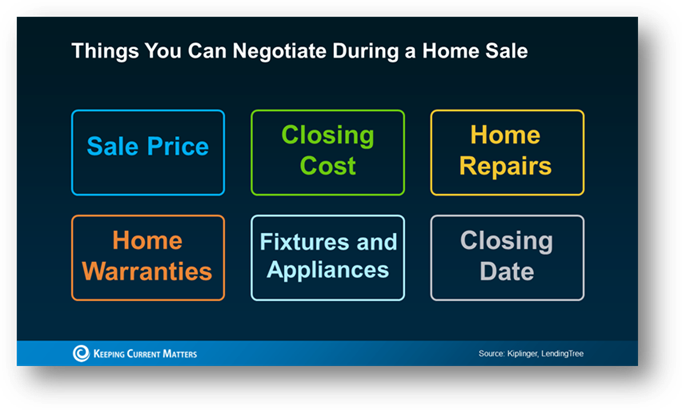
Qué puede negociar?

La mayoría de los aspectos en la compra de una vivienda están sobre la mesa de negociación. Aquí tiene solo algunos de esos elementos, según Kiplinger y LendingTree:

  • Precio de venta: El más evidente es el precio de la vivienda. Y este factor se está utilizando con mayor frecuencia hoy en día. Los compradores no quieren pagar de más cuando la asequibilidad ya es tan limitada. Y los vendedores que no son realistas con su precio de venta pueden tener que considerar ajustarlo.
  • Reparaciones de la vivienda: Con base en la inspección, el comprador tiene derecho a solicitar al vendedor reparaciones razonables. Si el vendedor no quiere hacerlas, puede ofrecer reducir el precio de la vivienda o cubrir parte de los costos de cierre, para que el comprador tenga el dinero y pueda afrontarlas por su cuenta.
  • Accesorios y electrodomésticos: Los compradores también pueden solicitar que se incluyan electrodomésticos o muebles en la venta. Que el vendedor incluya la lavadora y la secadora reduce los gastos que tendría el comprador al mudarse. Como vendedor, usted puede dejar los electrodomésticos existentes para endulzar la oferta para el comprador y comprarse unos nuevos en su próximo hogar.
  • Costos de cierre: Generalmente representan entre un 2% y un 5% del precio de compra de la vivienda. Los compradores pueden pedir al vendedor que pague algunos o todos estos gastos para reducir el efectivo que el comprador debe aportar al cierre.
  • Garantías de vivienda: Los compradores pueden pedir al vendedor que pague una garantía para la vivienda. Esto es excelente para compradores preocupados por los costos de mantenimiento que puedan surgir después de tomar posesión de la vivienda. Y, dado que esta concesión generalmente no es muy costosa para el vendedor, puede ser una buena opción para ambas partes.
  • Fecha de cierre: Los compradores pueden solicitar un cierre más rápido o más extendido según su propio calendario. El vendedor también puede defender lo que necesita según su mudanza para encontrar el compromiso adecuado.

Una cosa es cierta, ya sea que usted sea comprador o vendedor: su Programa de Propiedad de Vivienda para Empleados puede ayudarle durante todo el proceso. Pueden ayudarle a descubrir qué busca la otra parte, y esa información puede ser muy valiosa en la mesa de negociación.

En resumen

Los compradores están recuperando parte del poder de negociación en el mercado actual. Como comprador, conocer las palancas que puede accionar le ayudará a sentirse seguro y empoderado al hacer su compra. Como vendedor, anticipar lo que pueden pedirle le da la oportunidad de pensar qué estará dispuesto a ofrecer.

Quiere conversar más sobre qué esperar y las opciones que tiene? Conéctese con su Asesor del Programa de Propiedad de Vivienda para Empleados.

SupportSquad@AdvantageHomePlus.com | (800) 511-2197


La información y las opiniones contenidas en este artículo no deben interpretarse como asesoramiento en materia de inversiones. Advantage Home Plus no garantiza ni asegura la exactitud ni la integridad de la información u opiniones aquí contenidas. Nada de lo aquí expuesto debe interpretarse como asesoramiento de inversión. Usted siempre debe realizar su propia investigación y diligencia debida y obtener asesoramiento profesional antes de tomar cualquier decisión de inversión. Las contribuciones a las comisiones inmobiliarias están disponibles según lo permitan las leyes estatales.

A Record Number Are Planning To Buy in 2026 – Are You? – Spanish

      Un número récord planea comprar en 2026 — y usted?    

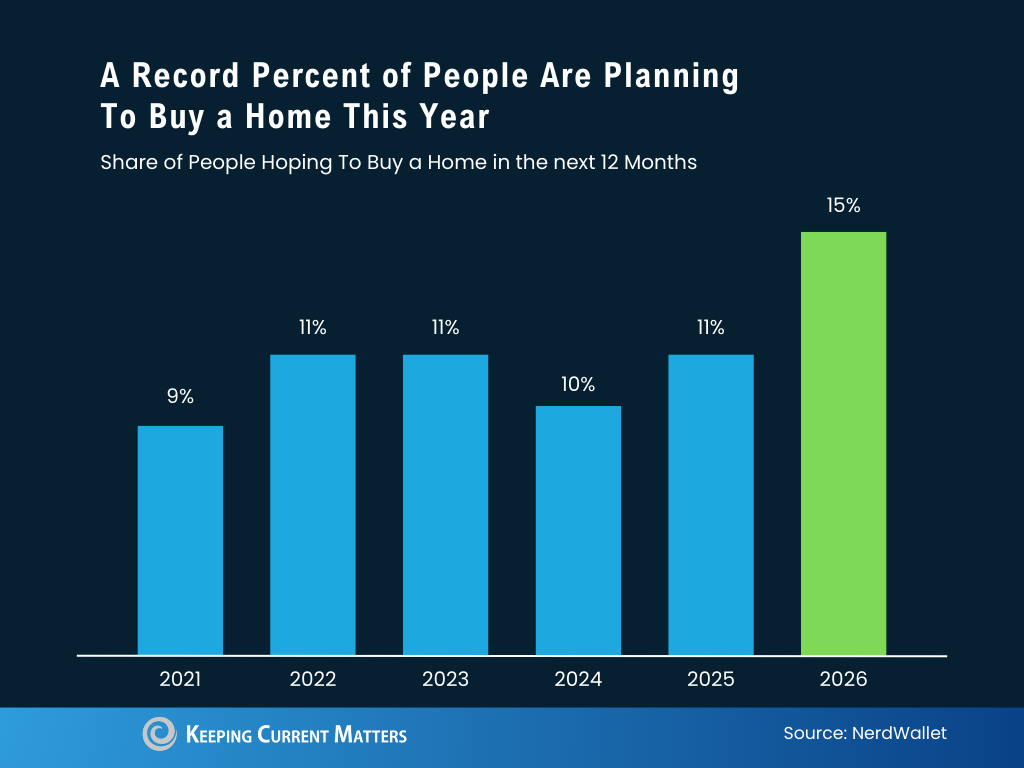
Este podría ser el año para vender su casa — y aquí le contamos por qué. Según una encuesta reciente de NerdWallet, el 15% de las personas planea comprar una vivienda este año. De hecho, esta cifra representa un récord histórico para esta encuesta (vea el gráfico a continuación):

Por qué esto es tan importante El porcentaje ha estado entre un 9 y un 11% desde 2021. Este aumento reciente muestra que la demanda de compradores no ha desaparecido; al contrario, indica que existe una demanda contenida lista para volver al mercado.

Eso no significa que se abrirán las compuertas ni que habrá una oleada masiva de compradores como vimos hace unos años. Pero sí señala que habrá más actividad este año que el anterior.
Al menos algunos de los compradores que habían pospuesto sus planes en los últimos años volverán a entrar al mercado. Ya sea porque se sienten más seguros para mudarse, porque finalmente han ahorrado lo suficiente para comprar, o simplemente porque no pueden esperar más: este es el año en el que planean dar el paso.

Y, según esa misma encuesta de NerdWallet, más de la mitad (54%) de esos posibles compradores ya han comenzado a buscar viviendas en línea.

Ese es un buen indicador de que varios de estos compradores estarán buscando durante la temporada alta de compra de viviendas esta primavera. Así que, si está pensando en vender su casa, es importante asegurarse de que su propiedad esté preparada, bien valorada y correctamente promocionada, para que pueda mostrársela a ellos.

En resumen

Más personas se van a mudar este año y, con la estrategia adecuada, usted puede asegurarse de que su casa sea una de las primeras que vean. Su Programa de Propiedad de Vivienda para Empleados puede ayudarle a crear una estrategia para que su casa sea vista por los compradores adecuados, se venda y maximice su beneficio.

Qué cree que les gustará más de su casa a estos compradores?
Conéctese con su Asesor del Programa de Propiedad de Vivienda para Empleados para comentarlo y asegurarse de que ese aspecto esté en primer plano en su anuncio.

SupportSquad@AdvantageHomePlus.com | (800) 511-2197


La información y las opiniones contenidas en este artículo no deben interpretarse como asesoramiento en materia de inversiones. Advantage Home Plus no garantiza ni asegura la exactitud ni la integridad de la información u opiniones aquí contenidas. Nada de lo aquí expuesto debe interpretarse como asesoramiento de inversión. Usted siempre debe realizar su propia investigación y diligencia debida y obtener asesoramiento profesional antes de tomar cualquier decisión de inversión. Las contribuciones a las comisiones inmobiliarias están disponibles según lo permitan las leyes estatales.